 WELCOME
TO OPEFE ARCHIVES
WELCOME
TO OPEFE ARCHIVES
Malaysian
Toothed Catfish
genus Belodontichthys
Etymology: Greek, belos, -eos = any projectile + Greek, odous = teeth + Greek, ichthys = fish
FROM FRANK MAGALLANES
Since originally writing this article in 1995, another species has been discovered and described in 1999. That species was named Belodontichthys truncatus.
The genus Belodontichthys
dinema was proposed by Bleeker (1858) in his revision of siluroid fishes.
The genus consisted of the type species (dinema) which he had previously
described as a member of the genus Wallago (Bleeker, 1851). Bleeker's
specimens were from Borneo; since then the species has been recorded from
Sumatra, Java, Laos, Vietnam, Thailand, Kampuchea, and Malaysia (Haig, 1959;
Kottelat, 1985, 1989, Roberts, 1989). The genus was originally recognized as
monotypic and assigned to the family Siluridae.
Even for a siluroid Belodontichthys has an extraordinary external
morphology.
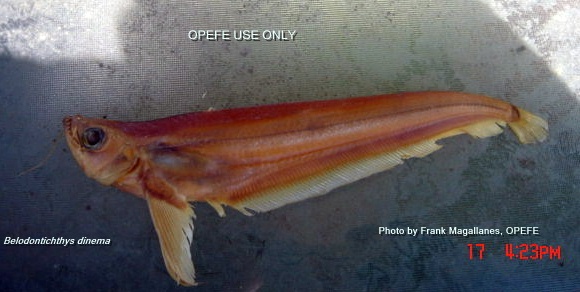
Dorsal soft rays (total): 4 - 4; Anal soft rays: 89 – 91. Upper part of head compressed, with a concave profile, lower surface broadly flattened, with a convex profile; cross section view of head thus presenting a triangular shape. Two pairs of barbels; maxillary barbels extending on pectoral fins, mandibulary barbels short, thread-like. Eyes covered by skin. Dorsal fin poorly developed, rays weak; anal fin long, united to caudal fin at their base; pectoral fins large.
TWO (or 3) VALID SPECIES
|
Belodontichthys dinema Bleeker 1851
synonym B. macrochir Southeastern Asia |
Belodontichthys truncatus Kottelat & Ng 1999.
Southeastern Asia: Mekong and Chao Phraya River basins |
Belondontichthys javanenss
Identity doubtful, might be a Wallago or an Ompok -- (Kottelat et al. 1993:68 Species inquirenda in Siluridae -- (Ferraris 2007:381 Indonesia
|
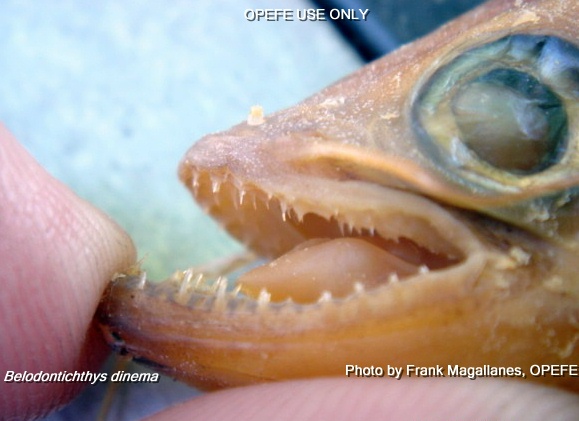
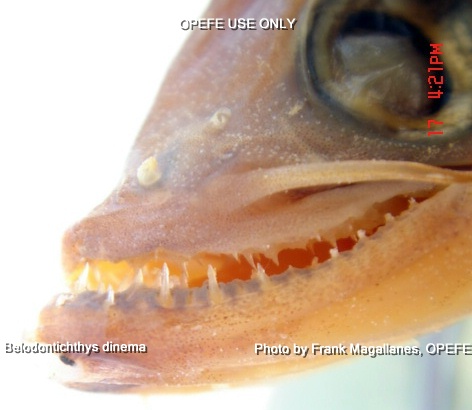
Belodontichthys dinema (200 mm SL). Photos by Frank Magallanes
The head is narrow with a straight to concave dorsal profile (formed by the anteriorly extended dorsal body musculature). The eyes are large, set at the corner of the mouth; the jaws long, and obliquely angled, with the lower jaw extending anteriorly beyond the upper; both jaws are armed with three rows of arrow-shaped tips. The maxiliary barbel extends only to the pelvic fins; and the single pair of mandibular barbels are shorter than the diameter of the eye. Gill-rakers are elongate, numbering ca 30.
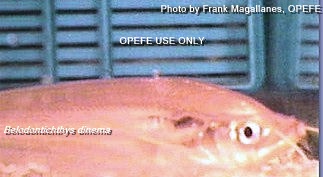
Live specimen of Belondontichthys dinema.
In spite its peculiar morphology, the anatomy of
Belodontichthys has not previously been described. Perhaps this is because
it is not abundant in museum collections although relatively common in nature (Haig,
1950).
The habits of Belodontichthys are poorly known. Smith (1945) remarks that
the fish occurs in deeper waters and feeds on migratory schools of young
cyprinids. We are informed by Mr. Chavalit Vidthayanon that the fish usually
stays close to the substrate or in the middle of the water column but takes its
prey from near the surface. Adults congregate in small groups of 5-10, subadult
groupings usually comprise of more than 10 individuals. Adults feed primarily on
fishes, and juveniles on insects and crustaceans. Eggs are adhesive. An
excellent game fish which can be caught using hook and line. Presently large
numbers are being taken near Stung Treng in Cambodia by explosives. Marketed
fresh or dried and salted. Examples of live B. dinema at OPEFE clearly
substantiates the observations by Mr. Vidthayanon. They tend to swim mid-water
and feed almost exclusively on small live fish.The head and jaws of juvenile
Belodontichthys appear much as in Wallago but during development the
jaws become obliquely aligned. Whether the epaxial muscle continues to extend
foRward onto the cranium during early development is unknown.
Belodontichthys falls into the category of teleosts which Ganguly &
Chatterjee (1963) referred to as 'bilaterally compressed snapping teleosts' and
in which they included Ompok and Eutropiichthys. Belodontichthys
displays a morphotype which at first sight one might label as typically that of
a 'neck-bending' teleost but closer examination reveals that this 'typical'
morphology in fact characterizes the converse functional situation, namely one
providing a rigid rather than flexible framework, presumably allowing more
powerful biting forces.
I coined the common name Malaysian Toothed Catfish after conferring with Mr. Lee Finley (1995), a well-published author and expert on catfishes. Mr. Finley was sent an OPEFE video of Belodontichthys while the specimen was being raised from a juvenile (6.5cm) to its mortality size of 26cm. Specimens imported into the United States are rare and often mistaken for genus Ompok. OPEFE maintains specimens in formalin.
REFERENCES
Cranial anatomy and phylogeny of the South-East Asian catfish genus Belodontichthys, G.J. Howes and Ayanomiya Fumihito (1990).
The Freshwater Fishes of Western Borneo (Kalimantan Barat, Indonesia) by Tyson R. Roberts, published by California Academy of Sciences (1989).
Bleeker, P. 1851.Vierde bijdrage tot de kennis der ichthyologische fauna van Borneo, met beschrijving van eenige nieuwe soorten van zoetwatervisschen. Natuurkd. Tijdschr. Neder. Indië 193-208
Kottelat, M. and H. H. Ng 1999 (Dec.) Belodontichthys truncatus, a new species of silurid catfish from Indochina (Teleostei: Siluridae). Ichthyol. Explor. Freshwaters v. 10 (no. 4): 387-391.
Click here to return to Other Predatory Fishes
CLICK HERE TO RETURN RESEARCH PAGE
The OPEFE web site and its contents; is disclaimed for purposes of Zoological Nomenclature in accordance with the International Code of Zoological Nomenclature, Fourth Edition, Article 8.3 and 8.4. No new names or nomenclature changes are available from statements at this web site.
Copyright© 1994-2012 Oregon Piranha Exotic Fish Exhibit (The OPEFE fish exhibit is permanently CLOSED as of 2000) Sutherlin, Oregon. Information posted on this web site is archival data on fish scientific classifications and other information. DISCLAIMER: The copyrighted material may not be used for any purpose other than private study, scholarship or research. Cited information requires credit and this link www.opefe.com. All rights reserved. All images shown (unless otherwise noted) is property of OPEFE.
UPDATED: 12/05/2015