The Science of Ichthyology, Defining Titles
By Frank Magallanes with contribution by Brian M. Scott
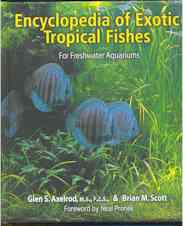
I'm deeply grateful to Brian M. Scott, Aquatic Editor of Tropical Fish Hobbyist Magazine for allowing me permission to use definitions found in Encyclopedia of Exotic Tropical Fishes For Freshwater Aquariums, Axelrod & Scott (2005).
With hobbyist who study and keep piranhas always looking for new methods to define their hobby, I thought it would be another great step to advance who we are to the world of tropical fish keeping.
For myself, I have always considered my hobby of piranha keeping as a piranha or Characoid researcher. Indeed, when I created OPEFE my original title was piranha researcher. Later, the news media and State Senate defined me as a piranha expert. So what am I really? What is the common advanced fish-keeping hobbyist who has no degree or school background called? The term amateur has always carried a stigma of lowliness among the elite. Those who feel far more superior to others. Indeed, there are scientist and some non-scientist who use the term as if it were vulgar. In reality, it is not a vulgar term nor is its use non-professional. Many famous people who practiced other fields and had degrees separate from ichthyology were amateurs. Astronomers are a good example. One only needs to find and read the annuals of discoveries to find out that amateur astronomers play an important part in this world. Indeed, if one were to really think about it, scientist use local people to find out about fishes and their behavior. Fishermen make up the foundation for scientists to build upon.
So we come to the definition as published by Scott et al.
According to Scott (2005):
Bionomic ichthyologists
The role of aquarists and hobbyists in ichthyology is broad. Many master aquarists are technically referred to as bionomic ichthyologists while advanced aquarists are sometimes considered amateur ichthyologists. Bionomic ichthyologists are specialists in the care, husbandry, propagation, and general aquariology of fishes. Their publications usually consist of society journals and magazines on the subject of fish keeping in general. Frequently, bionomic ichthyologists will publish books detailing techniques that resulted in their success with groups of fishes.
Bionomic ichthyologists usually have either a Bachelor of Science (B.S.) or a Master of Science (M.S.) degree in either biology or zoology with many credits being earned in fisheries science. In many cases, extra credits are obtained in aquaculture or other fish-related disciplines.
Amateur ichthyologists
Amateur ichthyologists are quite common in the realm of fish-keeping. They play an important role in the industry and often have management positions with large fish shops, importers, and wholesalers. Frequently, they breed fishes at home in their spare time and usually are quite active in fish clubs where they offer their guidance to younger, less-experienced hobbyists. As as education is concerned, amateur ichthyologists usually have a background in one of the biological sciences, but some have degrees in a completely unrelated subject such as accounting or education.
Systemic ichthyologists
Systemic ichthyologists are usually a completely different breed of scientist. It is uncommon for an ichthyologist doing systemic research to have anything less than a Master of Sciences, and the vast majority either have a PhD or are working toward the completion of one. Systemic ichthyologists are the taxonomists of the fish world. They are the key individuals for naming and classifying all fishes. Often, they work closely with ecologists, microbiologists, veterinarians, and a wide assortment of other professionals. These scientist live by the rule publish or perish and they often do so at an astounding rate. Many of their publications are submitted for peer review in one of the several scientific journals of the field.
Dictionary definitions:
Amateur
From the Latin amator: lover, devoted friend, devotee, enthusiastic pursuer of an objective.
The word amateur has at least two connotations. In the first, more widely used manner, it means someone performing some task without pay, in contrast to a "professional" who would be paid for the same task. In this sense, labeling someone an "amateur" can have a negative connotation. For example, amateur athletes in sports such as basketball or football would not be regarded as having ability on par with professional athletes in those sports.
Hobbyist
A person who pursues an activity in their spare time for pleasure.
Scientist
A person who has studied science, especially one who is active in a particular field of investigation.
a person who uses observation, experimentation and theory to learn about a subject (Biologists, physicists, chemists, geologists and astronomers are all scientists.)
a person with advanced knowledge of one or more sciences.
Systematist
Systematics is the study of the diversity of organism characteristics. In biology, systematists are the scientists who classify species and other taxa, which they do with the aim of defining how they relate evolutionarily.
Additional useful definitions are found here. As read in that link, there is a connection with someone doing a hobby and a professional. I agree, that in a literal sense a professional does indeed imply no enjoyment in what they are doing.
So what is my opinion of all of this? I think its important for hobbyist to value themselves on their deeds more than words or a title. The real expert on fishes at the hobbyist level does not need a title to sustain their credibility. Its their work, time and devotion they give to it that gives credibility. I'm very proud of my work to help the hobby and while there are always detractors out in cyber space, it does not mean they are right. You can measure your worth, by what you have done. So if being called an amateur ichthyologist is important to you, do not be ashamed to use it. Both Brian M. Scott and Glen Axelrod are respected people in their field. I support them in their quest to educate the hobbyist as I would support anyone else that showed a true desire to further the hobby, free from personal gain or ego.
In conclusion, I hope this topic has been useful for anyone reading it.
REFERENCES
Axelrod, Glen S. and Scott, Brian M. (2005) Encyclopedia of Exotic Tropical Fishes for Freshwater Aquariums, TFH Publications, Inc. Neptune City, NJ 07753, p. 23.
Axelrod, Herbert R. and Schultz, Leonard P. (1990) Handbook of Tropical Aquariums Fishes, TFH Publications, Inc. Neptune City, NJ 07753, pg.3-4.
USE YOUR BACKSPACE OR CLICK HERE TO RETURN RESEARCH PAGE
Copyright© 1994-2015 Oregon Piranha Exotic Fish Exhibit (The OPEFE fish exhibit is permanently CLOSED as of 2000) Sutherlin, Oregon. Information posted on this web site is archival data on fish scientific classifications and other information. DISCLAIMER: The copyrighted material may not be used for any purpose other than private study, scholarship or research. Cited information requires credit and this link www.opefe.com. All rights reserved. All images shown (unless otherwise noted) is property of OPEFE.
UPDATED: 12/04/2015