 WELCOME TO OPEFE ARCHIVES
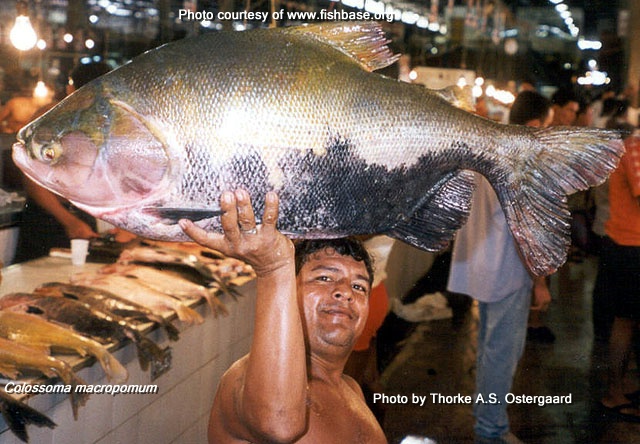
Colossoma macropomum
(Cuvier 1818)
Common Names: black pacu (tambaqui, cachama, black fin pacu)
FROM FRANK MAGALLANES
Grows to 400 mm SL, the young spotted, adults plain with the fins dark-brown. Many synonyms exist; C. oculus and C. nigripinnis. The adipose fin is also rayed in this species. This species occurs in the Amazon, as well as the Orinoco basin. The species occurs in the Amazon and Orinoco basins. This group was revised by Antonio Machado-Allison (1982), also provided keys for species identification. This fish is frequently misidentified by fish and wildlife authorities as a red-bellied piranha when captured in U.S. waters.
Tambaqui growth and survival when exposed to different photoperiods
Paulo Henrique Rocha ARIDE1, Rodrigo ROUBACH2, Sérgio Ricardo NOZAWA3 and Adalberto Luís VAL2
1UNINILTON LINS. Toxicologia Ambiental. 69058-040, Manaus, AM. aride@inpa.gov.br
2 Instituto Nacional de Pesquisas da Amazônia - INPA, CP 478, 69011-970, Manaus, AM.
3 UNINILTON LINS. Expressão Gênica. 69058-040, Manaus, AM.
ABSTRACT
The use of different photoperiods (light) were investigated during tambaqui (Colossoma macropomum) juvenile growth under captivity. Light intensity tested was: continuous dark (24hrs without light), natural photoperiod simulation (10hrs of light and 14hrs without light) and continuous light (24 with light). No mortality was recorded among treatments. Significant differences was observed after 50 days of experiment among mean fish weight, fish kept under a continuous darkness showed a better specific growth rate (6.02%) when compared to control fish (natural photo period, 3.67%). Fish exposed to continuous light presented the lowest mean specific growth rate (2.04%). It is possible to improve tambaqui juvenile weight gain performance when kept under continuous darkness.
REFERENCES
Machado-Allison, A. 1982. Estudio sobre la subfamilia Serrasalminae (Teleostei, Characidae). Prte 1. Estudio comparado de los juveniles de las "cachamas" de Venezuela (generos Colossoma y Piaractus). Acta Biologica Venezuelica 11(3):1-101
Araujo-Lima,C.R.M.; Goulding, M. 1997. So fruitful a fish: Ecology, conservation, and aquaculture of the Amazon's tambaqui. Columbia University Press, New York, NY. USA. 157pp.
Aride, P.H.R.; Roubach, R.; Val, A.L. 2004. Water pH in Central Amazon and its importance for tambaqui culture. World Aquaculture Magazine, U.S.A., v.35, (2): 24 28.
Berg, A.; Hansen, T.; Stefansson, S. 1992. First feeding of Atlantic salmon (Salmo solar L.) under different photoperiods. Journal of Applied Ichthyology, 8, 251-256.
Boef, G.; Bail, P.L. 1999. Does have light an influence on fish growth? Aquacultur, 177:129-152.
Boujard, T.; Moreau, Y.; Luquet, P. 1991. Entrainment of the circadian rhythm of food demand by infradian cycles of light/dark alteration in Hoplosternum littorale (Teleostei). Aquatic Living Resources, 4: 221-225.
Britz, P.J.; Pienaar, A.G. 1992. Laboratory experiments on the effect of light and cover on the behaviour and growth of African catfish, Clarias gariepinus (Pisces: Clariidae). Journal of Zoology, London 227, 43-62.
Chellapa, S.; Chellapa, N.T.; Barbosa, F.A.; Huntingford, F.A.; Beveridge, M.C.M. 1995. Growth and production of the Amazonian tambaqui in fixed cages under different feeding regimes. Aquaculture International, 3:11-21.
Gwinner, E. 1986. Circannual rythms, Zoophysiology vol. 18 Springer, Heidelberg, 154 pp.
Houde, E.D.; Schekter, R.C. 1981. Growth rates, rations and cohort consumption of marine larvae in relation to prey concentrations. Raap PV Reun.- Cons.Int. Explor. Mer. 178, 441-443.
Jobling, M. 1994. Fish bioenergetics. Chapman & Hall, 294pp.
Johnson, J.H.; Dropkin, D.S., 1995. Effectes of prey density and short term food deprivation on the growth and survival of American shad larvae. Journal of Fish Biology, 46, 872-879.
Jorgensen, E.H.; Jobling, M. 1989. Feeding modes in Artic charr, Salvelinus alpinus L.: The importance of bottom feeding for the maintenance of growth. Aquaculture, 86, 379-386.
Lam, T.J. 1983. Environmental influences on gonadal activity in fish. In: Fish Physiology vol. IX Reproduction part B- Behavior and fertility control. (Hoar, W.S.; Randall, D.J.; Donaldson, E.M. eds.). Academic Press. New York. p. 65-116pp.
Piaia, R.; Uliana, O.; Felipetto, J.; Radunz Neto, J. 1997. Alimentação de larvas de jundiá Rhamdia quelen com dietas artificiais. Ciência e Natura, 19, 119-131.
Piaia, R.; Townsend, C.R.; Baldisseroto, B. 1999. Growth and survival of fingerlings of silver catfish exposed to different photoperiods. Aquaculture International, 7, 1-5.
Roubach, R.; Correia, E.S.; Zaiden, S.; Martino, R.C.; Cavalli, R.O. 2003. Aquaculture in Brazil. World Aquaculture, 34(1): 28-34; 70-71.
Simensen L.M.; Jonassen, T.M.; Imsland, A.K.; Stefansson, S.O. 2000. Photoperiod regulation of growth of juvenile Atlantic halibut (Hippoglossus hippoglossus L.). Aquaculture, 190, 119-128.
Sioli, H. 1984. The Amazon and its main effluents: Hydrography, morphology of the river courses, and river types. In: The Amazon: Limnology and landscape ecology of a might tropical river and its basin. (Sioli, H. ed.). Dr. W. Junk Publishers. Boston. p. 127-163pp.
Stickney, R.R.; Andrews, J.W. 1971. The influence of photoperiod on growth and food conversion of channel catfish. Fish Culturist, 33, 204-205.
Thorpe, J.E. 1978. Rhythmic activity of fishes. Academic Press: London.
Val, A.L.; Honczaryk, A.1995. Criando peixe na Amazônia. Manaus: INPA 160pp.
Volpato, G.L.; Fernandes, M.O. 1994. Social control of growth in fish. Brazilian Journal of Medical and Biological Research, 27, 797-810.
USE YOUR BACKSPACE TO RETURN OR CLICK HERE TO VALID PHYTOPHAGOUS PAGE
CLICK HERE TO RETURN RESEARCH PAGE
The OPEFE web site and its contents; is disclaimed for purposes of Zoological Nomenclature in accordance with the International Code of Zoological Nomenclature, Fourth Edition, Article 8.3 and 8.4. No new names or nomenclature changes are available from statements at this web site.
Copyright© 1994-2012 Oregon Piranha Exotic Fish Exhibit (The OPEFE fish exhibit is permanently CLOSED as of 2000) Sutherlin, Oregon. Information posted on this web site is archival data on fish scientific classifications and other information. DISCLAIMER: The copyrighted material may not be used for any purpose other than private study, scholarship or research. Cited information requires credit and this link www.opefe.com. All rights reserved. All images shown (unless otherwise noted) is property of OPEFE.
UPDATED: 12/05/2015