Piranha Ecosystem, Biotopes and Aquariology
Defining a term for piranha hobbyists
by Frank Magallanes
Piranha Ecosystem, Biotopes and Aquariology
Defining a term for piranha hobbyists
by Frank Magallanes
FROM FRANK MAGALLANES
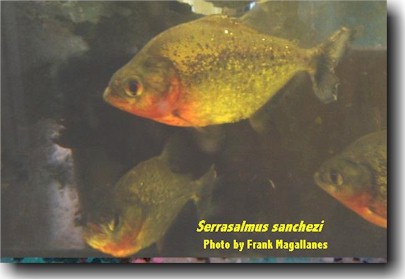
Grouping species like these S. sanchezi can be fatal or near fatal to other tank mates. The species is a notorious scale and fin biter. It will also keep nibbling away at the poor hapless fish that loses all its fins, until only a partial body remains! However, keeping them together as a singular group species can be a chore. Some success has been reported in large public aquariums, as well as mixing with Pygocentrus.
Most hobbyists dream of having an Amazonian ecosystem in their home. Problem is, you can't have a river system or pool of water that would harbor the countless animals found in that system. Instead what you the hobbyist can do is create a mini-ecosystem that can be a model of the larger scale found in Amazonia. Ecosystem has a broad use in the aquarium hobby as well as in scientific literature. Ecosystems show relationships with groups of organism and to each other and their environment. Accordingly, the following describes what an ecosystem consists of:
Ecosystems are composed of a variety of living organisms that can be classified as producers, consumers, or decomposers. Producers or autotrophs, are organisms that can manufacture the organic compounds they use as sources of energy and nutrients. Most producers are green plants that can manufacture their food through the process of photosynthesis. Consumers or heterotrophs get their energy and nutrients by feeding directly or indirectly on producers. We can distinguish two main types of consumers. Herbivores are consumers that eat plants for their energy and nutrients. Organisms that feed on herbivores are called carnivores. Carnivores can also consume other carnivores. Plants and animals supply organic matter to the soil system through shed tissues and death. Consumer organisms that feed on this organic matter, or detritus, are known as detritivores or decomposers. The organic matter that is consumed by the detritivores is eventually converted back into inorganic nutrients in the soil. These nutrients can then be used by plants for the production of organic compounds.
 In using piranhas genera Pygocentrus,
Serrasalmus, Pristobrycon and Pygopristis, we identify heterotrophs
or commonly called carnivores. Silver Dollars (herbivore) genus Metynnis
are also heterotrophs, but they eat autotrophs commonly known as plants.
We can now define what makes up a piranha ecosystem. For this you will need an
aquarium, water, gravel, plants, feeder fish and a filtration system to create
anaerobic bacteria. Living together, this term does not require compatibility
nor is it limited to just piranhas. It can be a closed system (not recommended
for piranhas) or open system where you provide the food and other nutrients.
In using piranhas genera Pygocentrus,
Serrasalmus, Pristobrycon and Pygopristis, we identify heterotrophs
or commonly called carnivores. Silver Dollars (herbivore) genus Metynnis
are also heterotrophs, but they eat autotrophs commonly known as plants.
We can now define what makes up a piranha ecosystem. For this you will need an
aquarium, water, gravel, plants, feeder fish and a filtration system to create
anaerobic bacteria. Living together, this term does not require compatibility
nor is it limited to just piranhas. It can be a closed system (not recommended
for piranhas) or open system where you provide the food and other nutrients.
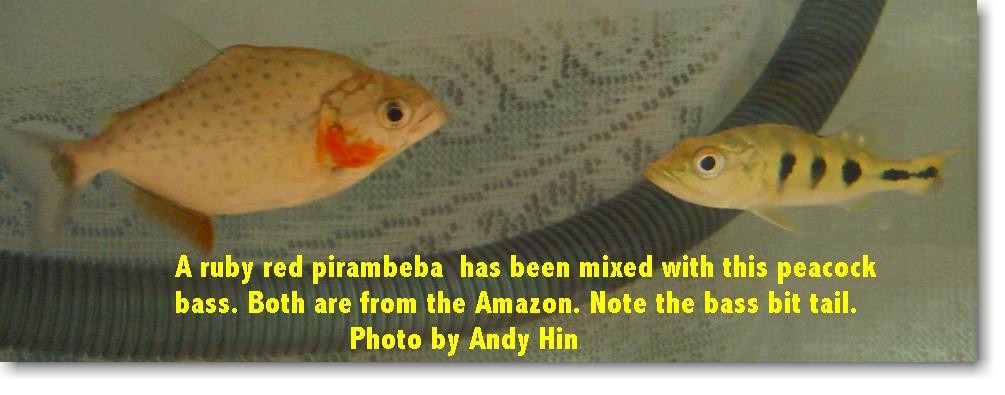
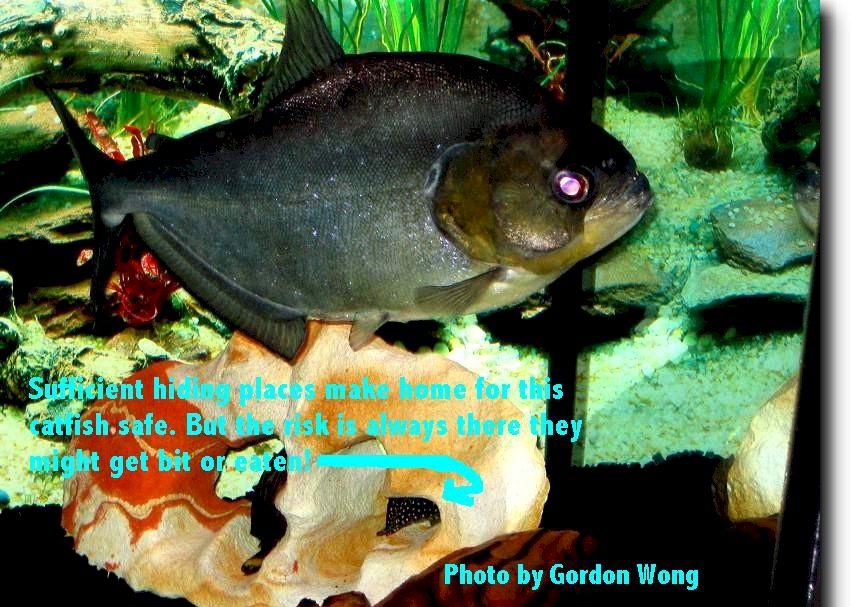
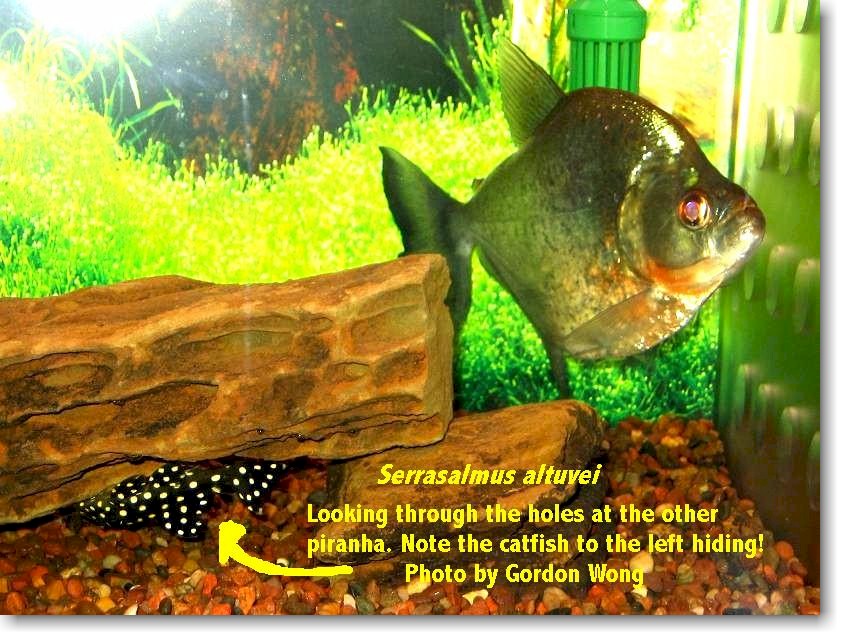
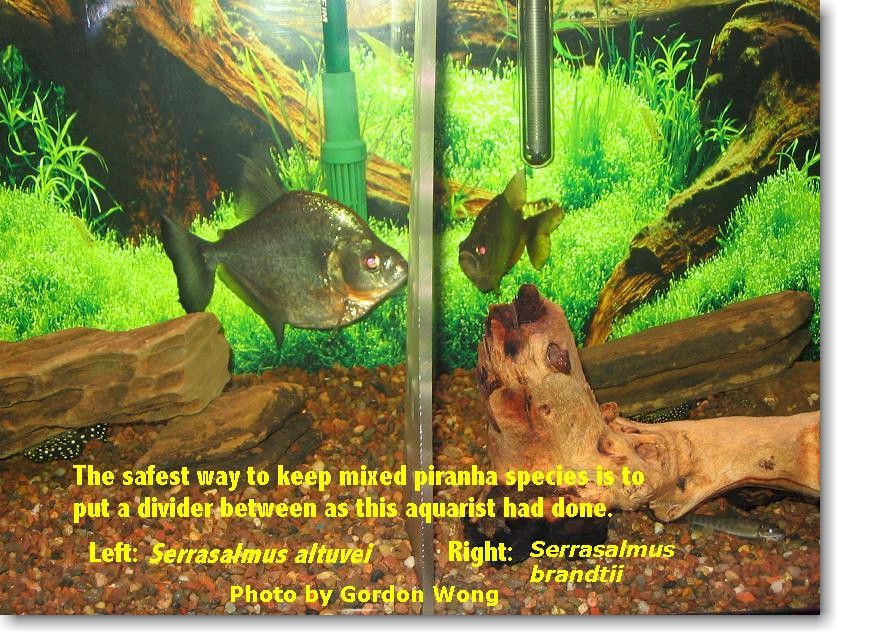
Aquarists could adopt this term piranha ecosystem as most accurate when they are mixing species or attempting to add non-piranha fish to their aquarium. A practice I do not recommend for the home aquarium. Few hobbyists, for example, have the knowledge to accomplish such a setup as described above. It certainly would have its problems though on a small scale such as a piranha aquarium.
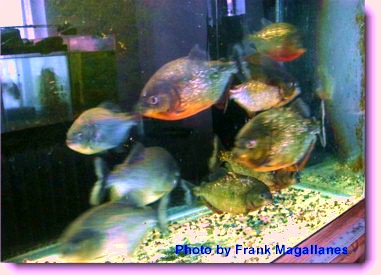
Some examples of species mixing
|
|
|
|
|
On line information useful information for aquarists:
Follow this link http://www.fi.edu/tfi/units/life/habitat/habact1.html and will provide you good advice on how to keep records.
Students can also find out why cohabitate is not a proper word to use with piranhas.
Find out why shoal may not be a good word to use with piranhas. Included in this work is why you shouldn't mix species of piranhas.
PIRANHA BIOTOPE
So what can we call a piranha aquarium? Basically, you can call it just that, a piranha aquarium or if you want something much more accurate the word "biotope." David M. Schleser, a biologist, professional photographer, author, and personal friend I deeply respect, used this term in his book on piranhas in the aquarium. The definition of a biotope is a small habitat in a large community.
PIRANHA AQUARIOLOGY
Another term is aquariology (Gratzek et al, 1992), which is the study of keeping fish in aquaria. It explores the reasons for keeping fish and requires a knowledge of the biological characteristics of fish, as well as of such aspects of their husbandry as feeding and nutrition. It also pertains to reproduction, water quality management, sources and control of stress, with disease control. This term is my favorite since I have used a variation of it for a number of years; Piranha Aquario.
REFERENCES:
PhysicalGeography.net, Michael Pidwirny, Ph.D Department of Geography, Okanagan University College, Kelowna, British Columbia, Canada. Copyright © 1999-2004 Michael Pidwirny
Schleser, David M. 1997 Piranhas, A Complete Pet Owner's Manual, Barron's Educational Series, Inc.
Gratzek,
J. B., Wolke, R. E, Shotts, E. B. Jr., Dawe, D., Blasiola, G. C., 1992
Aquariology Fish Diseases and Water Chemistry, pg. 1.
USE YOUR BACKSPACE TO RETURN OR CLICK HERE TO RETURN RESEARCH PAGE
TO RETURN HOME CLICK HERE
The OPEFE web site and its contents; is disclaimed for purposes of Zoological Nomenclature in accordance with the International Code of Zoological Nomenclature, Fourth Edition, Article 8.3 and 8.4. No new names or nomenclature changes are available from statements at this web site.
Copyright© 1994-2012 Oregon Piranha Exotic Fish Exhibit (The OPEFE fish exhibit is permanently CLOSED as of 2000) Sutherlin, Oregon. Information posted on this web site is archival data on fish scientific classifications and other information. DISCLAIMER: The copyrighted material may not be used for any purpose other than private study, scholarship or research. Cited information requires credit and this link www.opefe.com. All rights reserved. All images shown (unless otherwise noted) is property of OPEFE.