About the name Ternetzi
Rio Paraguay - basin Paraña or Piranha
Serrasalmo ternetzi synonym of Pygocentrus nattereri
Steindachner 1908
About the name Ternetzi
Rio Paraguay - basin Paraña or Piranha
Serrasalmo ternetzi synonym of Pygocentrus nattereri
Steindachner 1908
FROM FRANK MAGALLANES
Most hobbyists collecting piranhas for the home aquarium do not understand that in order for a species name to be valid, sufficient examples must be available and compared with a holotype. This method is to ensure the species is a valid distinctive species. S. ternetzi was unique and no further examples could be found to justify its placement other than being a synonym of P. nattereri. The species name "nattereri" is older and under The International Rules of Zoological Nomenclature requires when a new species is discovered and described the name of the designated species must be compared with all other valid species to ensure it is indeed a new species.
Fink (1993) places southern populations from that area under the species name P. nattereri which is appropriate for these highly variable populations.
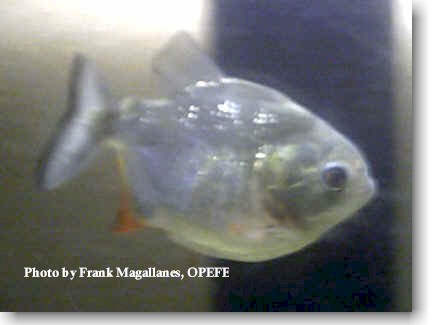
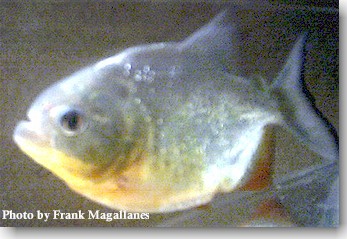
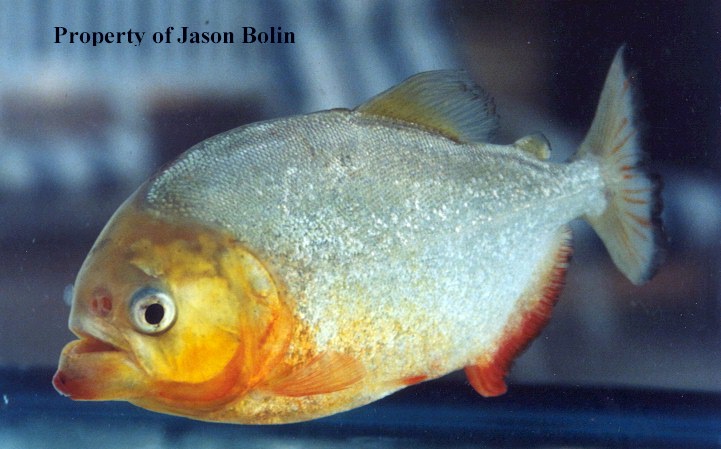
Some piranhas such as my Bent-nosed Piranha, FIG.1 AND FIG.2, P. nattereri, are genetic aberrations but not unreasonable to assume that wild piranhas also create such offspring adding variety to the gene pool. These are then captured by collectors who almost immediately think they have found a new species if there are more than a few when this are fished out. In the fish above, not only is the body more discoid and robust, but it also features an unusual anal fin that begins in-line in front of the adipose fin, the distance from the dorsal to the adipose is very short. I have been fortunate to keep many of these defects in the aquarium over the years. Some are so blunt-headed that no concavity appears over the eyes and the lower jaw can be extremely thick as well. See COMPARISON photo between a red-bellied and a yellow-bellied piranha.
The name Yellow Emperor, Yellow Belly, and Ternetzi is being applied by hobbyist for the yellow-bellied piranhas found in the southern portion of South America. In this photo one can see the high variability of head shapes from a single populations of red-bellied piranhas. Some even have larger lower jaws. Other's smaller depending on age and body shape. Hobbyist generally use their small samples of piranhas in the aquarium to formulate opinions and answers to the question; is there really an S. ternetzi? The answer itself must explored by what is known about this unique species. Then those characters in the description must be followed with sufficient quantities of specimens to reach a conclusion. Hobbyist are not able to secure sufficient examples of P. nattereri in their home aquarium because wholesale collectors do not import from all the areas of South America. Few examples of red-bellies are imported, most are from Argentina and Peru. Majority of the time, due to cost, home grown P. nattereri are offered for sale and since these are generally from the same location with no locality data, little variance is detected particularly to head shape when comparing to the wild caught. Hobbyist use vague terms when trying to compare their piranhas, such as; behavior, temperament, mood, etc., etc,. etc. They forget their fish is living in an unnatural environment which is the aquarium, so the behavior there is dictated by how the hobbyist provides the fishes living conditions. This may include an aquarium too small or overstocked with species (either same or different), water ( ie: pH), and temperature conditions are just a few considerations.
HISTORICAL SCIENCE
The holotype of S. ternetzi is lost to science, and the description itself is broad scoped (except for the unique anal fin), the bionomen nattereri has precedence over the much younger name ternetzi for the locality of where the original holotype was found (see below for more detailed information). If one were to follow Géry (1987) placement of the scientific name; P. nattereri would be appropriate for these southern species while S. altus (Pygocentrus) would be placed for the Amazonian piranhas and S. ternetzi would then become its junior synonym.
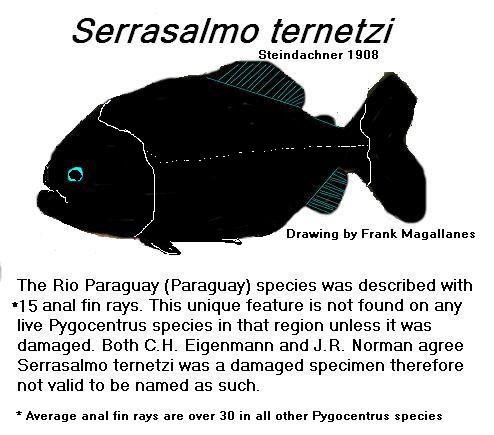
Pygocentrus ternetzi, was described by Steindachner (1908) from a single specimen found in the Rio Paraquay and was compared with P. piraya. Steindachner clearly wanted to differentiate the southern populations of Pygocentrus which were not P. piraya (restricted to the Rio São Francisco). However Steindachner did not compare nor mention P. nattereri in this comparison. The unique type specimen of S. ternetzi, now lost, apparently had a damaged anal fin, because it was supposed to have but 12 rays and have its origin on a vertical midway between the dorsal and adipose fins; neither attributes have been found in any other specimens of serrasalmin, and Eigenmann's supposition, supported by Norman, that the specimen was damaged, was reasonable.
In his key, Norman
differentiated S. ternetzi from P. nattereri using three specimens
(220-250 mm SL) and 40 specimens (75-270 mm SL), respectively based on the the
anterior profile (strongly arched vs moderately arched) and a few other
features. With the exception of two specimens from "Rio Plata," the
specimens Norman called S. nattereri were from the Amazon or Guyana. In
testing slopes and intercepts of regressions of these features against SL, no
significant differences between southern and Amazonian populations in these
features (as measured herein) were detected.
Géry et al. (1987) listed several characteristics that they took to indicate
that southern and Amazonian populations represent different species, suggesting
that the southern species retain the name P. nattereri and placing S.
ternetzi as a junior synonym of the former. Paraguay specimens were thought
to be different from Amazonian specimens in several features, including red
pigment absent from the belly (based on their examination of about 100 specimens
from Paraguay), greater convexity of the head, shorter and larger snout,
distance between the nares larger eye diameter, and "probably" with a
larger number of serrae and more scales (13 specimens were used for counts and
measurements). Fink (1993) investigated photographs taken in Paraguay and
Brazil. These photographs confirm that individuals in these populations do have
reduced pigmentation on the belly, relative to most Amazonian fishes; however
the amount of pigment, usually orange or yellow-orange, falls within the
variation found in Amazon area populations. Also, Fink was unable to confirm any
of the suppositions pertaining to body shape and meristics. He wrote that those
authors probably did not take into account individual and population differences
with their small analyzed samples. The convexity of the head shape of these
southern populations is difficult to quantify. Fink found no difference in head
shapes from the southern populations and Amazonian populations. Visual
comparisons also did not confirm differences in head convexity. Snout length did
appear to be short in large individuals from the southern populations, but it
was not significantly different from the Amazonian population.
Fink, in order to determine if there were any potential discriminators, measured snout length using a sub-sample of both populations of over 60 specimens of equal size and he found no statistical differences in slopes or intercepts of regression of snout length on SL. Distance between the nares being less than or larger than the eye, used by Géry et al. (1987). Géry used a comparison that conflates head width and eye size, one showing positive allometry and one negative allometry (interorbital width). Fink found no differences between southern and Amazonian populations in interorbital width or eye size in the specimens Fink used (determined by slopes and intercepts of each measured in a linear regression on SL). The prepelvic counts were also compared and the numbers garnered from that do not support a hypothesis for independent evolution in those groups. Géry suggested that the name S. altus (Gill 1871) be applied to Amazonian species while S. ternetzi (Steindachner 1908) be used for Paraguayan populations to differentiate them. The problem is, both these names are younger than P. nattereri. Both S. altus and S. ternetzi remain available for upper Amazon and Paraguay populations, respectively should they be found diagnosable (Fink 1993).
In 1997, Fink and Zelditch reviewed the description and all available citations pertaining to S. ternetzi. They could not find reliable characters to distinguish between the two, and consider S. ternetzi as a nonlinear cline (varying body shape) of P. nattereri.
THE SCIENTISTS THAT CLASSIFIED THEM
Steindachner
1908
Serrasalmo ternetzi
Known only from the following description of Steindachner:
Head 2.6; depth 1 4/7: D. II, 15; A. III, 12: scales 38 to 40-86 + 7-40 to 43; serrae in front of anus 27; eye 5 in the length of the head; interorbital 2.25: snout 2.33; base of anal 2.25; height of anal 2.33: base of dorsal 1.6; height of dorsal 2.25; length of pectoral 1.6; ventral 3; depth of caudal peduncle 2.75.
Snout short, blunt; lower jaw heavy as in piraya; suborbital leaving a narrow naked margin behind; origin of dorsal midway between snout and caudal, behind the vertical from the front of the ventrals; adipose fin about 6 in the length of the head; pectoral not reaching the ventral; anal scaled at its base, its margin convex; last anal ray about half as high as the first divided ray. Upper half of body with obscure dark, round spots.
Serrasalmo (Pygocentrus) ternetzi STEINDACHNER, Anz. K. Acad. Wiss. Wien., 1908, P. 359 (Descalvados on the Paraguay).
Google Translation from German:
Das \v. M. Hofrat F.
Steindachner berichtet über sechs neue Serrasalmo- und Myletes-Arten aus
Südamerika, von den vier von ihm während der zoologischen Expedition der
kaiserl. Akademie der Wissenschaften nach Brasilien im Jahre 1903 gesammelt
wurden, und zwar:
1. Serrasalmo (Pygocentrus) ternetzi n. sp. — In der Körperform genau mit Pyg.
piraya übereinstimmend, unterscheidet sich diese Art von allen bisher bekannten
Arten der Subgattungen Pygocentrus, Pygopristis und Serrasalmo durch die
auffallend geringe Zahl der Analstrahlen, die nur 2/18 beträgt. Die Höhe des
Rumpfes ist zirka l'/7mal, die Kopflänge 23/5mal in der Körperlänge (mit
Ausschluß der C), der Augendiameter zirka 5mal, die Stirnbreite 2l/4mal, die
Schnauzenlänge 21/3mal, die Länge der Anale 2'/4mal und deren Höhe zirka
21/3mal, die Basislänge der Dorsale zirka ls/5mal, die Höhe derselben 21/4mal,
die Länge der Pektorale l3/5mal, die der Ventrale zirka 3 mal, die Höhe des
Schwanzstieles 23/4mal in der Kopflänge enthalten. Schnauze kurz, stumpf;
Unterkiefer äußerst kräftig, wie bei Pxg. piraya. Der zweite untere
Augenrandknochen ist nach hinten durch einen schmalen Hautstieif vom Vorrande
des Präoperkels getrennt. Der Beginn der Dorsale ist ebensoweit von der
Augenmitte wie von der Basis der Kaudale entfernt und fällt in vertikaler
Richtung hinter den der Ventralen. Die Länge der faserstrahligen Fettflosse
beträgt nahezu 1/6 der Kopflänge. Die Spitze der Brustflossen erreicht nicht
die Einlenkungsstelle der Ventralen. Am Bauchrande liegen bis zur Analspalte 27
sägeartige Zähne, Anale nur nächst der Basis überschuppt, am unteren Rande
schwach konvex; letzterer Analstrahl zirka halb so hoch als der höchste erste
geteilte Strahl. D. 2/15, A.3/12, V. 1/(3, L. t. zirka 38 — 40/1/40—43, L.
1. zirka 86+7. Obere Rumpfhälfte mit nicht sehr deutlich hervortretenden
dunklen, runden Flecken. Bei Pygpiraya fällt der Beginn der A. in vertikaler
Richtung zirka unter die Basis des viertletzten Dorsalstrahles, bei der hier
beschriebenen Art aber zirka unter die Längenmitte des Abstandes des letzten
Dorsalstrahles von der Fettflosse. Ein Exemplar, zirka 15 cm lang, aus dem Rio
Paraguay bei Descalvados, von Dr. Ternetz gesammelt.
TRANSLATION FOR BABEL (Incomplete translation)
The \v. reported M. Hofrat F. Steindachner six new Serrasalmo-and
Myletes-species from South America, the four of him during the Zoological
expedition of kaiserl. Academy of Sciences were collected to Brazil in 1903,
namely:
1. Serrasalmo (Pygocentrus) ternetzi n. sp. -In the body shape with Pyg.
According to piraya, this species differs from all previously types of sub
genera of Pygocentrus conspicuous Pygopristis and Serrasalmo by the well-known
small number of the anal rays which is only 2 / 18. The height of the trunk is
about l ' / 7 times, the length of the head 23/5 times in the length of the body
(with exclusion of C), the eye diameter approximately 5 times the width of the
forehead 2 l/4 times, the snout length 3 21/times, the length the anal 2'/ 4
times and the amount of 3 approximately 21/times, the basic length of the dorsal
about ls/five, the amount of thereof 4 21/times, the length of pectoral l3/5
times, the ventral approximately 3 times the height of tail stieles 23/4 times
in the length of the head included. Snout short, blunt; Lower jaw very strong as
in Pxg. piraya. The second lower eye rim bone is separated from the front edge
of Präoperkels to the rear by a narrow Hautstieif. The start of the dorsal is
ebensoweit by the middle of the eye as removed from the base of the caudal and
vertically behind the the ventral. The length of the fiber supports FAT fin is
almost 1 / 6 of the length of the head. Not the Einlenkung site of the ventral
reached the top of the pectoral fins.
On the ventral edge 27 saw-like teeth, anal are up to anal columns only next to
the base of shingled, weakly convex on the lower edge; the latter anal beam
approximately half as high as the highest first split beam. D. 2 / 15, A. 3 /
12, v 1 /(3, L. t. zirka 38—40/1/40—43, L. 1. zirka 86+7. Obere
Rumpfhälfte mit nicht sehr deutlich
hervortretenden dunklen, runden Flecken.) Pygocentrus
piraya the beginning of fall of A. vertically around under the basis of
fourth last dorsal beam at the here described kind but approximately in the
center of the length of the distance of the last dorsal beam of the fat fin; One
example, about 15 cm long, collected from the Rio Paraguay at Descalvados, by
Dr. Ternetz.
|
Eigenmann 1915 Gastropristis ternetzi
p. 236 c. Anal short, with fifteen rays, its origin below the space between dorsal and adipose ; no teeth on the palate.....Gastropristis gen. nov. II. In this same revision, Eigenmann assigned Taddyella and Rooseveltiella as a generic ranking. |
Norman 1929 Serrasalmus ternetzi
Norman revised Eigenmann's work and did not recognize the subgroups. Both genera Taddyella and Gastropristis were not recognized by Norman (1929) because of the problems associated with them. Taddyella and Gastropristis were younger names than Serrasalmus p. 784 Synopsis of species b. Anterior profile rather strongly arched ; base of rayed dorsal 2 1/3 in depth of body, 3 1/3 to 3 1/2 times distance from the adipose fin p. 790 Habitat: Rio Paraguay. The type-specimen of S. ternetzi differed from all other species of Serrasalmus in having only *III 12 rays in the anal fin, the origin of which was situated below a point midway between the rayed dorsal and adipose fins. In other characters, however, Steindachner's description agrees closely with that given above, and I am inclined to agree with Eigenmann that the single type specimen had probably met with some accident. It is by no means uncommon to find examples of Serrasalmus in which portions of the fins have been bitten off, and sometimes partly regenerated. Herr Maximillian Holly informs me that the type cannot be found in the collection of the Vienna Museum, and must be regarded as lost. *III = first 3 anal rays |
WHERE HOBBYISTS FIRST LEARNED THE SCIENTIFIC NAME
GEORGE S. MYERS, The Piranha Book (1972) pg 30-34 Serrasalmus ternetzi
Myers described four (4) species of Serrasalmus dangerous to man, then listed them on pages 31-35. This list included the Schomburgk (1841) S. niger. Myers also used the common body description (for that time period) of these 4 species having vs. the inoffensive ones... "the broader and much blunter head, the much heavier and apparently shorter lower jaw, and the thicker (less compressed) body" to compare with pirambebas. He also stated, "Two of these species, S. piraya of the Rio São Francisco and S. ternetzi of the Rio Paraguay, have a muzzle so blunt that there is only a very slight concavity in the profile above the eyes, if any at all. S. nattereri of the Orinoco, Amazon, and Paraguay-Paraña systems normally has a slight concavity in the profile at this place, while S. niger of the Guiana region has a deeper concavity and narrower head, thus approaching the appearance of the more innocuous forms."
He also stated; "In size these dangerous species appear to differ from each other," ...."Two of the forms appear to grow larger than the others. Serrasalmus piraya"....."commonly reaches at least 20 United States inches (51 cm.) in total length, and is the largest and most dangerous species. S. niger of Guiana reaches at least 14 ½ inches since the type specimen in the Berlin Museum is that long (365 mm). The largest measured example on record known positively to be S. nattereri is the 27-cm. (10½-inch) example in the British Museum. S. ternetzi of the Rio Paraguay reaches almost 10 inches. Probably all of these four species sometimes grow from 2 to 4 inches longer than the above records would indicate."
Myers went on to describe "S. ternetzi Steindachner" as follows; "is a very blunt-headed species, agreeing in this with preceding" (ie; S. piraya), "known only from the Rio Paraguay in northern Argentina, Paraguay, and presumably in southwestern Brazil and the Rio Paraña. Probably it is common because natives do not distinguish it from the common species" (meaning; Pygocentrus nattereri). "It differs from the following species (i.e. S. nattereri) by the blunter head the shorter distance between the dorsal fin and the adipose. The largest recorded example is just under 10 inches in total length." Myer's made no mention of the "short" 15 rayed (soft spines) anal fin, which is unique to Serrasalmo ternetzi (Eigenmann, 1915 et al). All Pygocentrus species have more than 30 anal fin rays. Myer's further erred by stating the species was from northern Argentina.
Interestingly, when he went on to describe S. nattereri KNER, he said this; "Occasional examples" (meaning S. nattereri) "have fairly well developed rays in the adipose fin." Who knows what he was looking at when he wrote that, since S. nattereri does not have a rayed adipose fin at any time, S. piraya does! He further added; "The fresh-caught fish, especially males at or near the breeding season, are very bright, for the sides show much metallic blue and the underside of the head and the belly are smeared with brilliant red. Because of this the fish is often called piranha vermelha (see above)." What I find interesting here and Fink et al. have already determined by samples of populations from both regions, is what Myers says next; "Presumably the same color is found in the two preceding species" (ie., S. piraya and S. ternetzi). This portion written is largely ignored or overlooked by hobbyist when you try to convince them of the S. ternetzi description errors found in the book and on the internet. Hobbyist assume that "yellow" is the only belly color this form has! The species S. ternetzi if it actually existed would have been from Paraguay.
This yellow-form has been successfully bred in captivity (live home bred example) by a hobbyist in Ohio for quite a few years. The bright yellow belly distinguishes this "home grown P. nattereri" from the other commonly bred red piranhas found in pet stores.
Please read my seed feeding experiment. These piranhas started out with red-bellies later began developing a yellowish-gold tint after ingesting large quantities of seeds as their only food source.
The Paraguayan variety do lack the red found in the eye in some areas, but in science eye color is just one characteristic and cannot be held as a sole indicator of species identification nor head, color or body shape. I hope this finally puts to rest the question, is S. ternetzi a valid species. You cannot simply stick a name on a fish and expect it to have meaning without knowing all the parameters of why a scientific name is placed. And there will always be a few that will argue this point based on their limited knowledge and understanding of scientific methods of placing fish. Some pet stores sell Ternetzi as an Argentina species, but as written above the species was not described from that region. It was Descalvados on the Paraguay. P. nattereri species exhibit the wide range of belly color in that region from yellow-red-orange. In South America all piranhas in the southern portion call these P. nattereri "ternetzi" by fishermen and collectors. This is because of the published Piranha Book by G. S. Myers (1972). That name stuck among those people, but in science, it has no value and not recognized as valid.
By the way, the name Ternetzi derives from Carl Ternetz, a naturalist and this scientific name was erected to honor him
REFERENCES
Fink, W.L. 1993. Revision of the piranha genus Pygocentrus (Teleostei, Characiformes). Copeia 1993(4):665-687
MYERS, George S. (1972) The Piranha Book TFH Publications Inc.
Géry, J. 1976 (18 Mar.) Les genres de Serrasalmidae (Pisces, Characoidei). Bull. Zool. Mus. Univ. Amst. v. 5 (no. 6): 47-54.
Taphorn, D. C. 1992 The characiform fishes of the Apure River drainage, Venezuela. Biollania Edición Especial - No. 4. Monografias Cientificas del Museo de Ciencias Naturales, UNELLEZ -- Guanara, estado Portuguesa, Venezuela. 1-537.
Eigenmann, C. H. 1915 (Mar.) The Serrasalminae and Mylinae. Ann. Carnegie Mus. v. 9 (nos. 3-4): 226-272, Pls. 44-58.
Géry, J. 1972 (19 Dec.) Poissons characoïdes des Guyanes. I. Généralités. II. Famille des Serrasalmidae. Zool. Verh. (Leiden) No. 122: 1-250, Pls. 1-16.
Géry, J. 1977 Characoids of the world. T. F. H. Publications, Neptune City, New Jersey. Characoids World: 1-672.
Müller, J. and F. H. Troschel 1844 Synopsis generum et specierum familiae Characinorum. (Prodromus descriptionis novorum generum et specierum). Arch. Naturgeschichte v. 10 (pt 1): 81-99 + Zu pag. 99 (foldout).
Eigenmann, C. H. 1910 (12 Feb.) Catalogue of the fresh-water fishes of tropical and south temperate America. In: Reports of the Princeton University expeditions to Patagonia 1896-1899. Zoology. Catalogue v. 3 (pt 4): 375-511. [Also as a separate, issued 12 Feb. 1910 as: Catalog and bibliography of ...; Contr. Zool. Lab Indiana Univ. No. 76 (2).]
Machado-Allison, A. and W. L. Fink 1991 (Nov.) Notas sobre la sistemática del género Serrasalmus y géneros relacionados. Parte II: el género Pygocentrus en Venezuela. Acta Biol. Venez. v. 13 (no. 1-2): 109-135. [In Spanish, English summ.]
Fink, W. L. and M. L. Zelditch 1997 (18 Feb.) Shape analysis and taxonomic status of Pygocentrus piranhas (Ostariophysi, Characiformes) from the Paraguay and Paraná River basins of South America. Copeia 1997 (no. 1): 179-182.
Steindachner, F. 1908 Über sechs neue Serrasalmo- und Myletes-Arten aus Südamerika. Anz. Akad. Wiss. Wien v. 45 (no. 18): 359-367.
Gómez, S. E. and J. C. Chebez 1996 Peces de la provincia de Misiones. Chapter 4 in J. C. Chebez: Fauna Misionera. Catálogo sistemático y zoogeográfico de los vertebrados de la Provincia de Misiones (Argentina). L.O.L.A., Buenos Aires. Peces Misiones: 38-70 + Addenda 315-316.
Britski, H. A., K. Z. de S. de Silimon and B. S. Lopes 1999 Peixes do Pantanal. Manual de identificaçao. Embrapa. Serviçao de Produçal -SPI, Brasía, DF. Peixes Pantanal: 1-184.
CLICK HERE TO RETURN TO P. nattereri OR USE YOUR BACKSPACE
TO RETURN HOME CLICK HERE.
The OPEFE web site and its contents; is disclaimed for purposes of Zoological Nomenclature in accordance with the International Code of Zoological Nomenclature, Fourth Edition, Article 8.3 and 8.4. No new names or nomenclature changes are available from statements at this web site.
Copyright© 1994-2012 Oregon Piranha Exotic Fish Exhibit (The OPEFE fish exhibit is permanently CLOSED as of 2000) Sutherlin, Oregon. Information posted on this web site is archival data on fish scientific classifications and other information. DISCLAIMER: The copyrighted material may not be used for any purpose other than private study, scholarship or research. Cited information requires credit and this link www.opefe.com. All rights reserved. All images shown (unless otherwise noted) is property of OPEFE.