 WELCOME TO OPEFE ARCHIVESWELCOME TO OPEFE ARCHIVES
Serrasalmidae
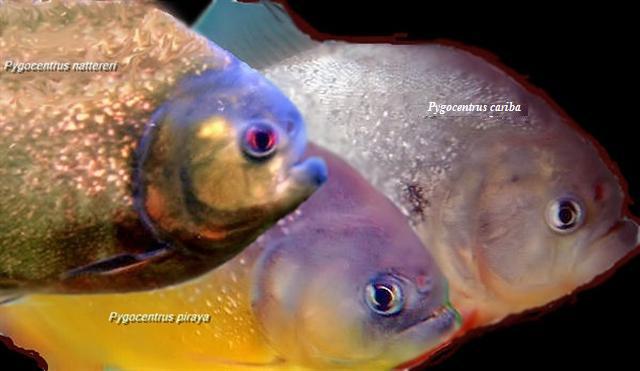
The three species of TRUE PIRANHAS and TRUE CARIBE
Potentially Dangerous To Man
genus Pygocentrus Müller & Troschel, 1844
Etymology: Greek, pygo = rump (or buttock) + Greek, centrus = center
Pronunciation guide .wav file.
FROM FRANK MAGALLANES
...but only four of these are true piranhas. That is, only four of the species are really known to be dangerous to man, and these are the only species invariably known as piranha in Brazil." (Myers, 1972, The Piranha Book pg. 22).
If you do not wish to read this entire page, can you click VIEW to access the species list and distribution.
I first became interested in true piranhas in 1957. Prior to the 1960's few people outside of science circles hardly knew what a piranha was. The few that did only assumed the animal was a man-eater similar to sharks, but would attack in large numbers and turn you into a skeleton in moments if you dared enter its waters. Further, most uninformed people (myself included) assumed the fish was from Africa based on the old Tarzan movies of the 1930's that aired in the 1950's.
BLOOD THIRSTY MAN EATER
Even today, people fear the fish based on what former President Theodore Roosevelt wrote in his adventures into the Brazilian wilderness. His tales of the man-eating piranha have even been made into Hollywood movies during the 1970's and into the 2000's, where mechanical piranhas are used for the gory scenes. Now animation CGI (PIRANHA 3D) is being used by Hollywood to create fake piranhas and spare the audience no gross inaccuracies about the animal. Not only was its natural behavior over zealously exaggerated, so was the biology and physiology of the fish. (SEE: Dr. William L. Fink from the University of Michigan Neotropical Division VIEW). And now in 2010, Mega Piranha full of nonsense and the same old tried and true horrific images to terrify viewers, including a huge Mega Piranha larger than King Kong and even Godzilla. It goes out to swallow an entire Navy fleet. One even devours a helicopter in flight. Yes, Hollywood is not yet done in its ignorant quest to foster another generation of fear mongering about piranhas to the public-at-large. The people in the world believed that piranha could fly and live out of the ocean water to attack humans and chase them around on land!
All the species eat plant matter and seeds, something in Eigenmann (1917) time would not have been considered nor acceptable to theorize about. It was believed in those days, the piranha would get plant matter in their gut from dining on plant eating fish. These were the scientific explanations for finding fish parts and plant matter in the piranha stomach. Yes, no one at that time could have conceived that piranhas also eat seed and nuts, not just fish. VIEW
P. nattereri, the species often associated with attacks on humans eats on a normal basis, Paspalum repens a tufted annual, with culms sprawling up to 2 meters long; flowering and fruiting August-October. This plant grows quite extensively on the banks of the Amazon and also serve as hiding spots for juveniles of all species.
HARALD SCHULTZ
Thanks largely in great part to Harald Schultz, the Brazilian anthropologist, the image of the piranha has changed considerably (Piranha Fact and Fiction,1964). Schultz stated: For more than twenty years my travels as a student of Indian life in connection with a scientific institute in Brazil have taken me to many far distant parts of the country. In all these years I have never had a harmful experience with these greatly feared piranhas.
ATTACKS ON HUMANS
Today, there have been some recent citations that document attacks on humans by piranhas, namely S. maculatus and S. rhombeus. But the reader should be aware, these attacks were not without provocation. In South America human interference is again pushing fish populations into death traps and the piranha is being cornered into human made dangerous situations. Dam building and man-made lakes are trapping piranhas and destroying habitat for many rare species of fish and fauna. Areas that were once spawning grounds for piranhas are being disrupted by humans to create recreational boating and swimming areas. Human attacks have occurred. Fortunately, most were minor with only loss of toes in a few cases in these areas. These cases involved S. spilopleura (S. maculatus). The area was once a spawning ground for this species. 15 people were reportedly bit in an area created for public recreational use.
In another case a woman accidentally fell into water from a dock where Amazon fishing boats dump the fishes offal. Allegedly, the young woman had her femoral artery severed by the bites and died from bleeding out (source: D. M. Schleser. 12/4/2011. Will check this out further for accuracy).
In December 7, 2011 it was reported by Practical Fishkeeping (SEE) an 18-year-boy bled out from having been bit by piranhas and died (on December 1, 2011). According to reports, the boy was a fisherman and familiar with that part of the river in Rosario del Yata. The river is 400 miles north of the Bolivian capital La Paz. He was reportedly drunk and jumped into the river from his canoe. Police in Bolivia suspect the boy used the piranhas to commit suicide. UK newspapers are carrying the story and linking it with James Bond movies and the 1978 Hollywood movie remake of Piranhas!!! As if these sources were factual information (SEE). Still, attacks are rare and not as often as sharks.
All red bellied species are potentially dangerous to any person or animal falling into the water near a regular fish cleaning site or under water bird rookeries located in flooded regions. Here, they have become conditioned to anything dumped or falling into the water being food.
PIRANHAS IN THE AQUARIUM
Any species of piranhas should be considered dangerous when it comes to the potential of a bite. Some hobbyists even report hand-feeding their fish. This is a very dangerous and stupid practice. These animals are not able to distinguish between bait and flesh and the potential is there for a human to suffer a nasty bite, including amputation of a digit. So don't do it no matter how friendly you think your piranha behaves.
The aquarium trade imported few of the species, mostly during the early 1960's. These were considered as a novelty fish. They commanded high prices for large specimens. But was not unusual to find the common juvenile red-bellied P. nattereri offered for sale at today's prices ($4.99). So in that regard, not much has changed.
However, the other Pygocentrus species, were not distinguished from P. nattereri. It was simply considered unique only because of the humeral spot. The same went for P. piraya, except for the flaming sides and rayed adipose fin. Both P. species and P. piraya did not actually become fully available until the mid 1990's and since then, they have become fairly common in dealers aquariums for individual purchase.
Scientists are examining the fish more closely than ever before and new information is giving the fish a more serious, well-needed makeover. They are indeed misunderstood and over hyped on the man-eating tendencies. It is now known these fish form loose groups in the wild and do not school (shoal) with any regularity.
DAVID M. SCHLESER
Like Harald Schultz, Dave as he likes to be called, is a dentist by trade who changed careers later in life and became curator of the Dallas Aquarium, Amazon explorer, photographer and amateur scientist. Dave has been to the Amazon numerous times. His wonderful writings and books about piranhas has helped foster a better understanding of the piranha. Much in the same tradition as Schultz. In Schleser book, Piranhas, A Complete Pet Owner's Manual, published by Barron's Educational Series, Inc., Dave gives the best current (2008) account of piranhas to date. I was fortunate along with some members (hobbyists) of a piranha forum to help Dave create this great book. It was the first time in hobbyist piranha book history that identifications were properly executed. With the exception of 2 mistakes on page 79 where S. hastatus was erroneously captioned as S. altispinus (spelling wrong, should be altispinis) and S. altispinis captioned as S. hastatus. This error was made by the publisher and not the writer (Schleser). Anyone interested in keeping piranhas as pets, should buy a copy of this book. Still available at Amazon.com or via my OPEFE home page Available at Fetch Book.com.
DNA
Several recent publications regarding DNA have been published:
1) Phylogeography of the piranha genera Serrasalmus and Pygocentrus: implications for the diversification of the Neotropical ichthyofauna (Nicolas Hubert, et al. 2007a).
2) Molecular systematics of Serrasalmidae: Deciphering the identities of piranha species and unraveling their evolutionary histories (Barbie Freeman, et al). In the first paper, their findings suggest that the present results emphasize that an interaction among geology, sea-level changes, and hydrographical created opportunities for cladogenesis in the piranhas at different temporal and geographical scales.
The second paper, they found evidence for a well-supported clade comprised of Pygocentrus, Serrasalmus, and Pristobrycon (in part). The sister group to this clade is also robustly supported, and consists of Catoprion, Pygopristis, and Pristobrycon striolatus. According to these authors, if the term piranha is to refer to a monophyletic clade, it should be restricted to Serrasalmus, Pygocentrus, and Pristobrycon (in part), or expanded to include these taxa plus Pygopristis, Catoprion and Pristobrycon striolatus.
My reservations about the Freeman et al., is the use of the term true piranha in the citation to imply those fish would be considered piranha when Myers (1972) has already defined the term on pg. 22 of The Piranha Book and restricted to certain fish. It could be this published account is ignored by some authorities when it comes to common name usage. So I disagree with this part of the abstract and their conclusion.
Both papers state that there is much more work to be done and I wholeheartedly agree with them.
A newer scientific document concerning biogeography; edited by James S. Albert and Roberto E. Reis 2011 Historical Biogeography of Neotropical Freshwater Fishes. University of California Press explains further problems with the Hubert and colleagues study on page 161, they write:
The suggestion by Hubert and colleagues (2007a) that those intracratonic arches may have played a role in determining vicariant events for the clade comprised by Serrasalmus and Pygocentrus species should also be dismissed as a gross misinterpretation of the nectectonic processes in the lower Amazon, which were much more complex than a simple model of such deformation (e.g., J. Crosta eat al., 2001). Though the lower Amazon River is a relatively "recent" addition to the western-central Amazon River ecosystem. Incorporated into the system since the breaching of the Purus arch, dated either as taking place during the late Miocene. 8 MY (Lundberg et al. 1998: Costa et al, 2001) or late Pliocene, -2.4 MY (Campbell et al. 2006), faunistic differences between the portion of the basin from the upstream reaches of the basin seems more likely to be due to ecological rather than to historical, factors.
GENUS PYGOCENTRUS
The historical scientific genera names for piranhas have undergone a multitude of changes. Some of these historical names are still found in various State laws where piranhas are prohibited and the invalid names grossly used. Below is the list of authors and the reasoning why these names were originally proposed for those species regarded as piranhas. Piranhas were only given a cursory glance by historical authors when these fish were first placed. This changed as improved methods to analyze fishes, including usage of radiography of specimens (to better see the bones and teeth) and the most recent method using DNA sequences of mitochondrial (mt) rRNA genes. The number of species loosely called piranhas is around 60 species or more. But only three (3) are true piranha.

Discussing Los Peces Caribes de Venezuela manuscript
Though not yet fully resolved, the systematic of Pygocentrus has been revised by Fink (1993) and followed up in subsequent works (Fink and Zelditch 1995, 1997), and Machado-Allison, 2003. A diagnosis for the three species comes from the first work (p.665) shown below. Please take the time to read the material throughout the entire OPEFE web site. Each species is covered extensively with material, both scientific and personal knowledge by this author. One other species to consider is the Southern population of Pygocentrus nattereri, also called ternetzi. In the Piranha Book by Dr. G. S. Myers. He mentions occasionally examples of P. nattereri having a rayed adipose fin. When I discussed this with Dr. W. L. Fink, we were not sure what Myers was looking at when he made that statement. Subsequently, I was able to secure a photo of a P. nattereri from that region with 2 spiny rays extending from the adipose fin. I have not been able to find any further specimens with this feature since 1997.
But the search continues.
HOLOTYPE/HISTORICAL LISTING OF GENERIC RANKING
Historical ichthyologists lumped all nominal species under genus Pygocentrus because they did not consider the morphology. They also did not evaluate the worn-down palatine teeth. Because of this, it would present a monumental problem since it included species that were not Pygocentrus. The list in later years would later be revised into a genera and subgenera using names like; Rooseveltiella, Taddyella etc. These authors included Serrasalmo piraya (Cuvier 1819) a true piranha, Serrasalmo niger (Schomburgk 1841), a pirambeba and Pygocentrus nigricans (Müller & Troschel, 1844), also a pirambeba. The description of the name Pygocentrus itself is very vague. Scientists of that day used morphometric and live colors and tended to overlook certain features that could have helped present day taxonomists. Serrasalmo albus is a good example of potential problems and argument. The species was revised as Serrasalmus cariba. This change removed the original Pygocentrus cariba into a new Pygocentrus species status.
Many of the historical piranha images, were not photographs at all but drawings. Artists at the museum colored in the drawings based on what the collector had written on their notes from the expedition and collections. Some of these drawings were stylized from the period. Often giving the piranha an odd appearance. In the early 20th Century radiographs began to be used. When the HOLOTYPE was lost, this was all that remained. Also added to the problem was some ichthyologists at museums simply tossing the fishes into jars and forgetting about them. Or mixing them up with the wrong label.
This is just a small part of the reason why piranha classification is so messy today.
DIAGNOSIS
The diagnosis of the species was characterized by external observations that applied to almost any species of piranha (except the species piraya with its rayed adipose fin) using words like; lower jaw very heavy, including a convex dorsal outline between dorsal fin and the snout tip, a well-ossified third infraorbital, lack of ectopterygoid teeth, and a few other features, usually vaguely described (Fink 1993). It was at best, difficult to ascertain the actual fish described for this genus name (save one, P. piraya). That is why original descriptions of piranhas are so vague for anyone to determine species easily.
Today, phylogenetic, DNA, biogeography and parasitism are being used as better methods to determine species. Yet, mistakes are still being made (see species S. maculatus). Sometimes the rush to publish (publish or perish) is overwhelming to some scientists and mistakes are made. But that's one of the things that make us human!
PIRANHA FORUMS
In reviewing various internet forums specializing in piranhas as pets, one can still find vague references in describing their piranha pet similar to the earliest scientist methodology. These hobbyists present out of focus photographs and sometimes no photograph at all, just a description. I am expected to identify their fish accurately. An impossible task, yet there are other hobbyists that do try and are often wrong on their identification. They overlook features on the piranha. Most just see the coloration and make assumptions..
There are also situations in these forums where a hobbyist that has little knowledge of the species and attempts to give credible information only find out the information is outdated or worse, just plain wrong. Such is the type of information found in today's world-wide web.
Advanced hobbyist are becoming more sophisticated now and are able to determine factual information from hype or from those amateur's that are building home pages or forums based on erroneous or largely personal opinion based data on their care of fish or what they heard from other people without quoting the source.
While the care and husbandry of these fish are important, everyone should keep in mind that the science is just as important and both go hand in hand in exploring these creatures.
New hobbyists should always research their ideas and opinions before expressing them. No sense looking foolish on the web. The science of understanding piranhas has been on-going for over100 years and much of what today's hobbyists are learning in their aquariums is actually very close to what has already been learned in field examinations.
Below is a summary of the changes that have occurred over the years from the beginning.
THE CLASSIFICATION HISTORY: Genus Pygopristis has always historically remained a monotypic ranking
|
Pygocentrus (Müller & Troschel, 1844) The genus Pygocentrus was erected by Müller & Troschel because they wanted place the type species of Pygocentrus piraya. The fish lacked ectopterygoid teeth (palatine teeth) and possessed a unique feature found only on this species of piranha; a rayed adipose fin and other features pertaining to head, body shape. |
Pygocentrus (Valenciennes, 1850) This grouping listed one true piranha, two pirambeba, and an invalid name that was probably a pacu (Myletes), respectively; This author placed 5 species in Pygocentrus; Serrasalmo piraya (Cuvier 1819), Serrasalmo niger (Schomburgk 1841), Pygocentrus nigricans (Müller & Troschel, 1844), Pygocentrus nigricans (Spix, 1829) and Pygocentrus palometa (Valenciennes 1850) nomen dubium. |
Pygocentrus (Eigenmann & Eigenmann 1891) In this grouping, two true piranhas, one pirambeba and caribito were placed; Serrasalmo piraya (Cuvier 1819), Serrasalmo niger (Schomburgk 1841), Pygocentrus altus (Gill 1870), and Pygocentrus scapularis (Gunther 1864). |
|
Gastropristis (Eigenmann 1915) The genus name Gastropristis was erected by Eigenmann for Serrasalmo ternetzi (Steindachner, 1908). This singular described specimen was based on the important (and unique) anal fin. The type specimen's anal fin was damaged (mutilated) and the type species eventually lost. No other type from that region has ever been collected that would fit the uniqueness of this described species (see ternetzi ); One type species; G. ternetzi (Steindachner 1908). |
Pygocentrus (Eigenmann 1915) This grouping listed 3 true piranhas and a species still considered valid that was probably a pacu (Myletes palometa = Myleus schomburgkii); The author revised the genus and included 4 species; Pygocentrus piraya (Cuvier 1819), Pygocentrus nattereri (Kner 1869), Pygocentrus notatus (Lutken 1874) and Pygocentrus palometa (Valenciennes in Cuvier & Valenciennes 1850) but as a nomen dubium (= dubious name). No types known. |
Serrasalmus (Norman 1929) Norman solely used this genus for all the species of piranhas, pirambeba, caribito and palometa. Effectively lumping them. He did not recognize the subgroups. Both genera Taddyella and Gastropristis were not recognized by Norman (1929) because of the problems associated with them. Taddyella and Gastropristis were younger names than Serrasalmus. Norman also erred egregiously by misspelling the subfamily as "Serrasalmininae". |
|
Serrasalmus (Mago 1970) Places 2 species in this genus; Serrasalmus nattereri (Kner 1869) and Serrasalmus notatus (Lutken 1874). Both of these species are true piranha. |
Serrasalmus (Géry 1976) In this grouping, non-Pygocentrus (pirambeba, caribito and palometa) and true piranhas were mixed together; Géry split the group into genus Serrasalmus and 2 species in subgenus Taddyella without recognizing this included non-Pygocentrus-like fish. Both Géry (1976) and Machado-Allison (1985) demonstrated that Pristobrycon and Pygocentrus should be maintained because of the number of various species. Géry resurrected Taddyella and placed this as a subgenus to Serrasalmus; The species included Taddyella nattereri (Kner 1869), Taddyella niger (Schomburgk 1841), Tadyella nigricans (Spix 1829), Tadyella notatus (Lutken 1874), and Tadyella ternetzi (Steindachner 1908). |
Serrasalmus (Géry 1977) Again, Géry revised the genus again, this time placing Pygocentrus as a subgenus to Serrasalmus with the species; Pygocentrus piraya (Cuvier 1819), and Pygocentrus manueli (Fernández-Yépez 1967). |
|
Rooseveltiella (Eigenmann 1915) These fish were indeed true piranhas and three (3) species; R. nattereri (Kner 1869), R. notatus (Lutken 1874), and R. stigmaterythraeus (Fowler 1911) were placed under this genus. Both Rooseveltiella (Eigenmann 1915) and Taddyella (von Ihering 1928) were erected to honor President Theodore Roosevelt. These names were substituted because Eigenmann wanted to restrict piraya as a unique Pygocentrus from the rest of the piranhas because of the rayed adipose (considered an apomorphy of this species). So the name Taddyella and Rooseveltiella were the result (Fink 1993). The reason the genus name Rooseveltiella is invalid was because it was already being used on another group of animals (see History of Ichthyology). |
Pygocentrus (Fernández-Yépez 1967) Only one species of true piranha was listed here. The rest were pirambeba and caribito; Places 6 species in this genus; Pygocentrus nattereri (Kner 1869), Serrasalmo niger (Schomburgk 1841), Pygocentrus scapularis (Gunther 1864), Pygocentrus manueli (Fernández-Yépez 1967), Pygocentrus striolatus (Steindachner 1908), and Pygocentrus serrulatus (Valenciennes 1850). |
Pygocentrus (Machado-Allison 1985; Fink 1991, revised 1993) This was the first attempt to determine the actual species placement using a new method using Phylogenetics; Dr. Antonio Machado-Allison (1985) revised the nomenclature standing of the piranhas by placing individual species identified by cladistic and Phylogenetic methods into a genera of 4 names; Pygocentrus (true piranhas- 3 species), Serrasalmus (30 or so species), Pristobrycon (10 or more species), and one species in Pygopristis. Other species reviewed included the generic ranks of Catoprion and vegetarian serrasalmin (Piaractus and Colossoma etc.). |
THE KEY TO THE SPECIES - Pygocentrus
There are additional complications concerning ectopterygoid teeth that Pygocentrus lacked. According to Machado-Allison (2002:56) reported early juveniles (>10mm SL) do possess 6 or more minuscule, unicuspid teeth on the ectopterygoid bone. This would be in contrast to the Fink 1993 Revision of Pygocentrus and the key features. However, this feature is temporary. Pygocentrus also has a pre-anal spine.
Dr. William L. Fink (1991) reviewed the genus, then revised the individual species for genus Pygocentrus (1993) and included an actual key in identifying species of true piranha. Fink based his diagnosis on the following......"Relative to other serrasalmin, Pygocentrus is diagnosable by several features, including prepelvic serrae number, morphology of the gas bladder and skull, and head width. There are three species in the genus: P. piraya, P. nattereri, and P. cariba. P. piraya is diagnosed by presence of adipose fin rays; it is restricted to the Rio Sao Francisco of Brazil. P. nattereri is undiagnosed, and highly variable in pigmentation. Its included populations are found in tropical and subtropical South America, east of the Andes, including the Amazon basin, the Paraguay and Paraña system, and the rivers of the Guiana's and northeast Brazil.
P. cariba is diagnosed by presence of four supraneurals and a dark, prominent humeral blotch; it ranges through the Rio Orinoco and its tributaries in Colombia and Venezuela. A key to the species is provided (see top of page). All extant types or members of type series are illustrated. Morphometric analyses found no significant shape differences among the species; body shape is extremely stable both ontogenetically as well as within populations.
In contrast, color pattern in both preserved specimens and in life is highly variable ontogenetically and within populations." Fink also made an argument for the placement of the epithet "cariba" noting that an error was made in the original description and epithet. Nico (2001) followed up and wrote; "the species name is more likely a species of Serrasalmus than a Pygocentrus." Subsequently, Serrasalmus cariba was delegated as a synonym of Pygocentrus cariba (See CAS, March 2012).
The genus Pygocentrus is characterized by several anatomical key features;
1a. Adipose fin in large individuals with rays. Branched dorsal-fin rays 15-18, usually 16;6-8, usually 7 neural spines anterior to first dorsal-fin pterygiophore; vertebrae 36-39, usually 38................................................P. piraya.
1b. Adipose fin without rays. Branched dorsal-fin rays 14-18, usually 15; 5-7, usually 6 neural spines anterior to the first pterygiophore; vertebrae 35-38, usually 36................2
2a. Large dark humeral spot in specimens over 100 mm SL; few body spots above that size; 4-5, usually 4 supraneurals.................P. cariba.
2b. Humeral spot relatively small or lacking at all sizes; body spots may be numerous; 4-5, usually 5 supraneurals........................P. nattereri.
|
CURRENT SPECIES AND THE COUNTRY RANGE - 2012 |
CONTRIBUTORS AND ADVISORS
Dr. Paulo Petry
Dr. William L. Fink
Dr. Antonio Machado-Allison
Dr. Michel Jégu
REFERENCES
Fink, W. L., 1993 Revision of Piranha Genus Pygocentrus (Teleostei, Characiformes), Copeia, 1993(3),pp.665-687.
Géry, Jacques, 1977 Characoids of the World, ISBN 0-87666-458-3, TFH H-961
Nico, Leo., 2000, (pers. com.) Nonindigenous Aquatic Species, Pygocentrus nattereri Kner 1860 and the American Fisheries Society publication website.
American Fisheries Society Publication, 1996, Cold Tolerance of genus Pygocentrus nattereri in the United States.
Machado-Allison, Antonio., Fink, William., 1996 Los Peces Caribes de Venezuela, Diagnosis, Claves, Aspectos Ecologicos Y Evolutivos.
Oral presentations - IX Meeting of the Neotropical Ichthyological Association, Antonio Machado-Allison and William L. Fink, Universidad Central de Venezuela, Museo de Biologia, Apto Correos 47058, Caracas, 1041-A. Venezuela.
Schulte, Wolfgang, 1988, Piranhas In The Aquarium (TS-117) TFH Publications, NJ.
Myers, George S., 1972, The Piranha Book (M-539) TFH Publications, NJ.
Quinn, John R. 1992, Piranhas Fact and Fiction (TS-172) TFH Publications, NJ
Schleser, David M. 1997, Piranhas, A Complete Pet Owner's Manual (ISBN 0-8120-9916-8) Barron's Educational Series Inc. NY
Catoprion Müller & Troschel 1844:96. Masc. Serrasalmus mento Cuvier 1819. Type by monotypy. Valid as Catoprion Müller & Troschel 1844 -- (Géry 1972:207, Géry 1976:54, Géry 1977:294, Taphorn 1992:149, Britski et al. 1999:58. Catoprion Müller & Troschel 1844. Characidae: Serrasalminae.
Gastropristis Eigenmann 1915:238. Fem. Serrasalmo (Pygocentrus) ternetzi Steindachner 1908. Type by original designation (also monotypic). Synonym of Serrasalmus Lacepède 1803, but as a synonym of the later subgenus Taddyella von Ihering 1928 -- (Géry 1976:52. Synonym of Pygocentrus Müller & Troschel 1844 -- (Taphorn 1992:308, Fink 1993:668. Pygocentrus Müller & Troschel 1844. Characidae: Serrasalminae.
Pristobrycon Eigenmann 1915:245. Masc. Serrasalmo (Pygocentrus) calmoni Steindachner 1908. Type by original designation. Synonym of Serrasalmus Lacepède 1803, but a valid subgenus -- (Géry 1972:210, Géry 1976:52, Géry 1977:278. Valid as Pristobrycon Eigenmann 1915 -- (Taphorn 1992:305. Pristobrycon Eigenmann 1915. Characidae: Serrasalminae.
Pygocentrus Müller & Troschel 1844:94. Masc. Serrasalmus piraya Cuvier 1819. Type by subsequent designation. Type designated by Eigenmann 1910:442. Synonym of Serrasalmus Lacepède 1803, but a valid subgenus -- (Géry 1976:52, Géry 1977:290. Valid as Pygocentrus Müller & Troschel 1844 -- (Taphorn 1992:308, Fink 1993, Machado-Allison & Fink 1991:109, Fink & Zelditch 1997:179, Britski et al. 1999:62. Pygocentrus Müller & Troschel 1844. Characidae: Serrasalminae.
Pygopristis Müller & Troschel 1844:95. Fem. Pygopristis fumarius Müller & Troschel 1844. Type by subsequent designation. Type designated by Eigenmann 1910:441. Synonym of Serrasalmus Lacepède 1803, but a valid subgenus -- (Géry 1972:209, Géry 1976:52. Valid as Pygopristes Müller & Troschel 1844 -- (Taphorn 1992:312. Pygopristis Müller & Troschel 1844. Characidae: Serrasalminae.
Rooseveltiella Eigenmann 1915:240. Fem. Pygocentrus nattereri Kner 1858. Type by original designation. Not available; preoccupied by Rooseveltiella Fox in Siphonaptera [not investigated]; replaced by Taddyella Ihering 1928. In the synonymy of Serrasalmus Lacepède 1803, subgenus Taddyella Ihering 1928 -- (Géry 1972:226, Géry 1976:52. In the synonymy of Pygocentrus Müller & Troschel 1844 -- (Taphorn 1992:308, Fink 1993:668. Pygocentrus Müller & Troschel 1844. Characidae: Serrasalminae.
Serrasalmo Duméril 1806:146, 342. Masc. Salmo rhombeus Linnaeus 1766. Type by subsequent designation. Latinized on p. 342. Type designated by Fowler 1950:279 [not researched]. Perhaps not intended as a new name -- Serrasalmo Lacepède in parentheses; apparently can be regarded as an incorrect subsequent spelling. Objective synonym of Serrasalmus Lacepède 1803. Serrasalmus Lacepède 1803. Characidae: Serrasalminae.
Serrasalmus Lacepède 1803:283. Masc. Salmo rhombeus Linnaeus 1766. Type by monotypy. Serrasalmo is a misspelling or unjustified emendation. Valid as Serrasalmus Lacepède 1803 -- (Géry 1972:208, Géry 1976:52, Géry 1977:278, Géry et al. 1987:449, Taphorn 1992:328, Britski et al. 1999:66. Serrasalmus Lacepède 1803. Characidae: Serrasalminae.
palometa, Pygocentrus Valenciennes in Cuvier & Valenciennes 1850:296 [Hist. Nat. Poiss. v. 22; ref. 1014]. Río Apuré, Río Guerico, Lower Río Orinoco, Venezuela. No types known. •Listed as valid as Pygocentrus palometa Valenciennes 1850 but as a nomen dubium -- (Jégu in Reis et al. 2003:189. Pygocentrus palometa Valenciennes 1850. Characidae: Serrasalminae. Distribution: Orinoco R. basin, Venezuela. Habitat: freshwater
Taddyella Ihering 1928:45. Fem. Pygocentrus nattereri Kner 1858. Type by being a replacement name. Replacement for Rooseveltiella Eigenmann 1915, preoccupied by Rooseveltiella Fox 1914 in Siphonaptera. Synonym of Serrasalmus Lacepède 1803, but a valid subgenus -- (Géry 1972:237, Géry 1976:52, Géry 1977:291. Synonym of Pygocentrus Müller & Troschel 1844 --(Fink 1993:669). Pygocentrus Müller & Troschel 1844. Characidae: Serrasalminae.
N. Hubert, F. Duponchelle, J. Nunez, C. Garcia-Davila, D. Paugy, and Jean-Francois Renno (2007) Phylogeography of the piranha genera Serrasalmus and Pygocentrus: implications for the diversification of the Neotropical ichthyofauna, Molecular Ecology, Blackwell Publishing, Ltd.
B. Freeman, L. G. Nico, M. Osentoski, H. L. Jelks, and T. M. Collins (2007) Molecular systemics of Serrasalmidae: Deciphering the identities of piranha species and unraveling their evolutionary histories. Zootaxa 1484: 1-38.On Line: www.mapress.com/zootaxa/
Nico, L. G. 2001 Alexander von Humboldt (1769-1859): contributions to knowledge of new world fishes. BioLlania Ed. Esp. no. 7: 127-165.
USE THIS LINK TO ACCESS PYGOCENTRUS SPECIES LIST
USE THIS LINK TO RETURN TO RESEARCH PAGE
The OPEFE web site and its contents; is disclaimed for purposes of Zoological Nomenclature in accordance with the International Code of Zoological Nomenclature, Fourth Edition, Article 8.3 and 8.4. No new names or nomenclature changes are available from statements at this web site.
Copyright© 1994-2012 Oregon Piranha Exotic Fish Exhibit (The OPEFE fish exhibit is permanently CLOSED as of 2000) Sutherlin, Oregon. Information posted on this web site is archival data on fish scientific classifications and other information. DISCLAIMER: The copyrighted material may not be used for any purpose other than private study, scholarship or research. Cited information requires credit and this link www.opefe.com. All rights reserved. All images shown (unless otherwise noted) is property of OPEFE.
UPDATED: 12/06/2015