Piranha Saicanga
Serrasalmus hollandi
Reinhardt in Lutken, 1874
Piranha Saicanga
Serrasalmus hollandi
Reinhardt in Lutken, 1874
LEFT Serrasalmus hollandi? -Bolivia
FRANK MAGALLANES
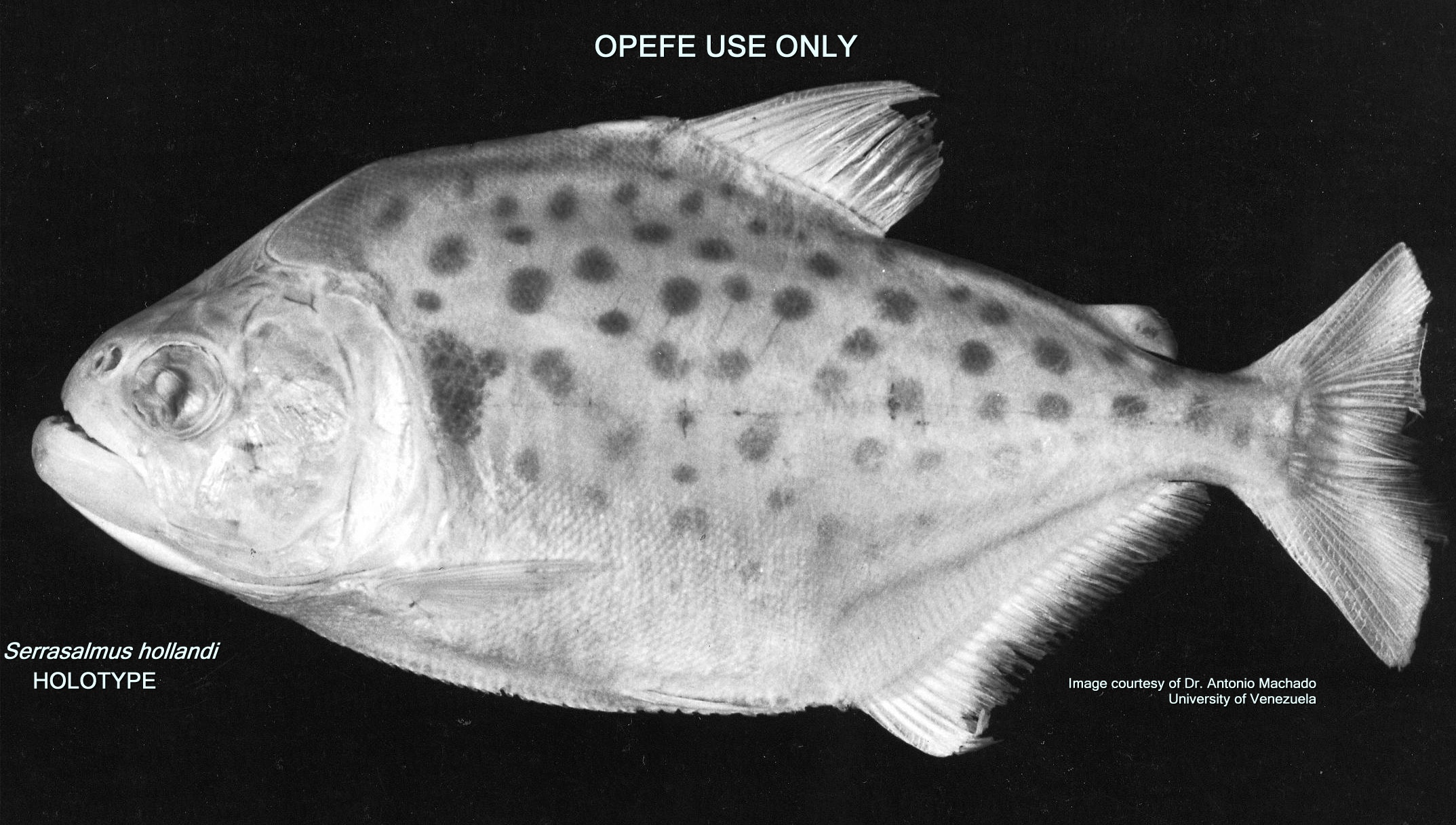
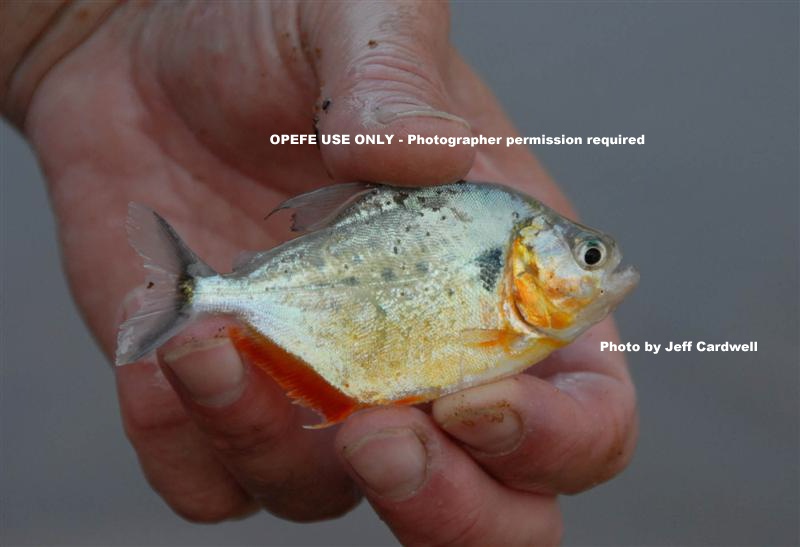
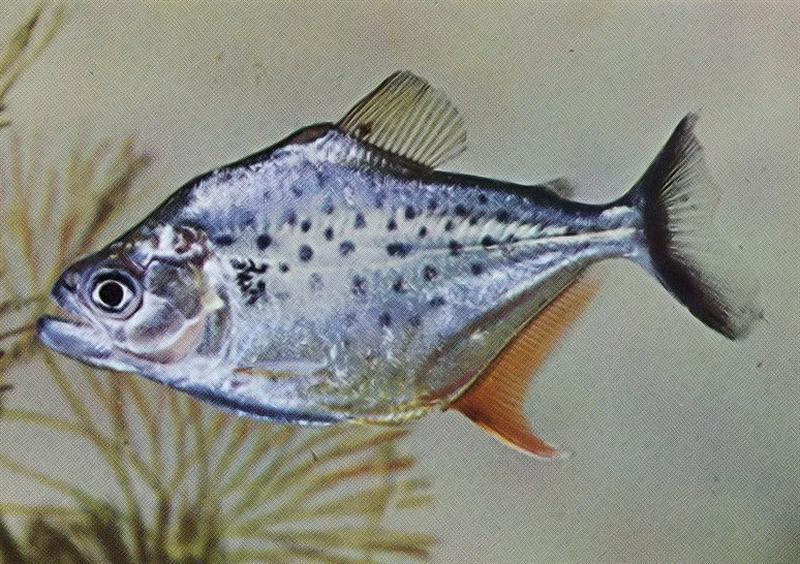
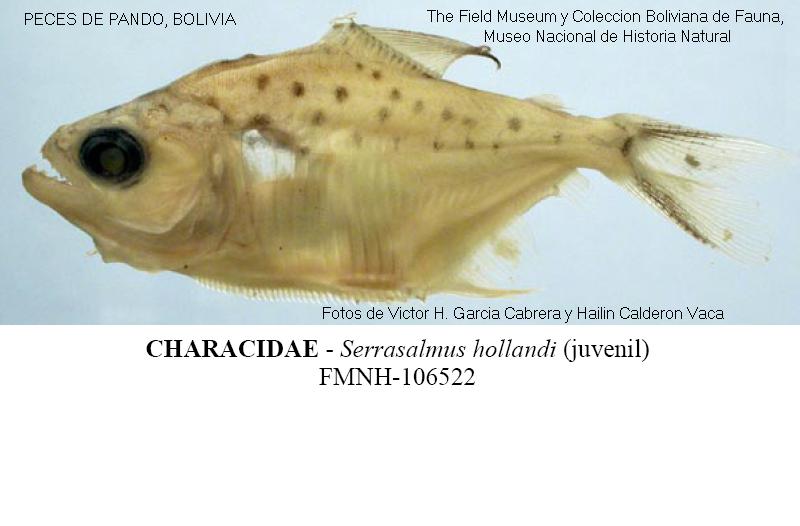
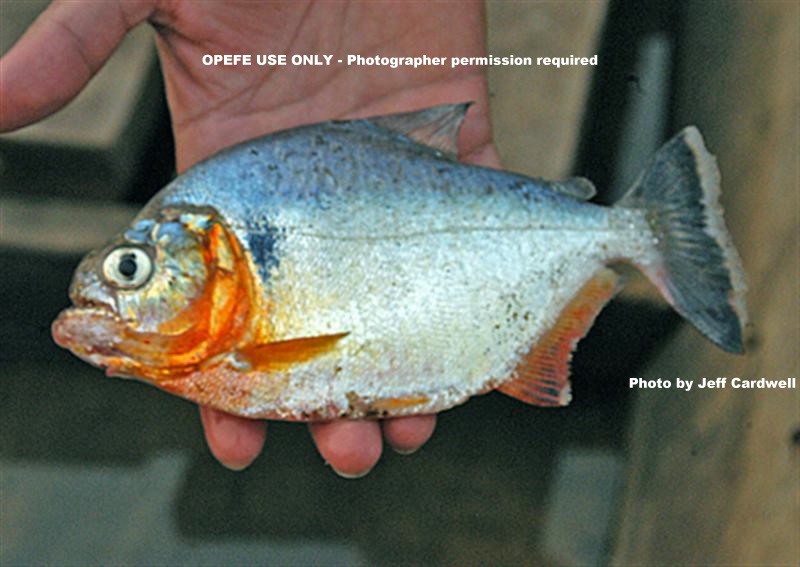
Questionable species, though the name is scientifically valid at this time. S. hollandi was described from the Rio Guapore. The species was compared by M. Jégu & Dos Santos (2001) with S. eigenmanni and S. aureus. The species name remains valid as of this date, though the holotype is lost. A number of fishes imported into the hobby are not S. hollandi but some other species, namely S. eigenmanni, a similar appearing widespread species. The fish on the left (bottom) is the holotype image of S. hollandi while the image at the top left resembles a live S. hollandi from Rio Guapore. This photo appears in The Piranha Book edited by G.S. Meyers (1972). The image on the bottom right, is a specimen collected from Pando, Bolivia and is cataloged as S. hollandi.
|
Holotype |
S. hollandi? juvenile Rio San Martin, Bolivia |
S. hollandi? The Piranha Book, G. S. Myers |
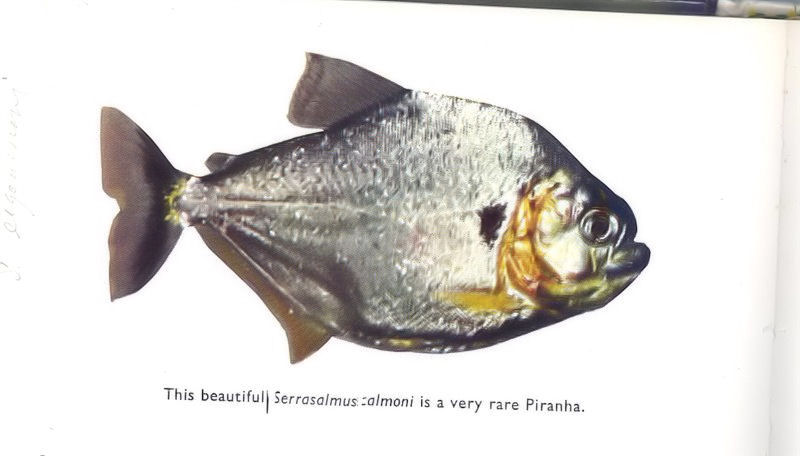
S. calmoni?, a species appearing similar to S. hollandi? The Piranha Book, G. S. Myers, page 84 |
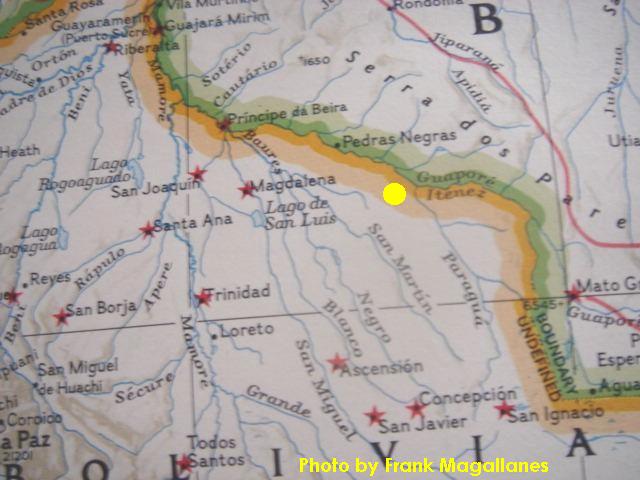
Map of geographical locality range |
juvenile specimen identified by authority to be S. hollandi (Bolivia). |
The species is based on a single specimen described. Holland's piranha is rhomboid with a prominent humeral spot on the flank. The species is heavily spotted, but spotting diminishes midway to the belly area. The caudal fin edging is hyaline and a very dark blotch in a form of a "V" is prominent on the hypural margin extending out. The holotype image (see top) provided to OPEFE by Dr. Antonio Machado is of an S. hollandi at approximately 109 mm SL. According to Dr. William L. Fink he has many species cataloged as S. hollandi by South American collectors, majority are S. rhombeus juvenile forms.
The species collected from southern Brazil and Bolivia as S. hollandi are believed by some authorities to be S. (Pristobrycon) eigenmanni a similar appearing species. In my own experience with seeing hundreds of these imported into the aquarium trade, the fish being purchased as S. hollandi are often times, S. sanchezi juvenile forms from Peru. Other forms being imported as S. hollandi appear to be a juvenile form of S. compressus another wide-spread species. The imported species also present the terminal caudal band, except S. sanchezi, depending on locality may exhibit a near hyaline tail band giving the appearance of having only a dark "V".
Hobbyists are cautioned against purchasing any species of piranha being sold as S. hollandi as questionable at the present time.
DESCRIPTION
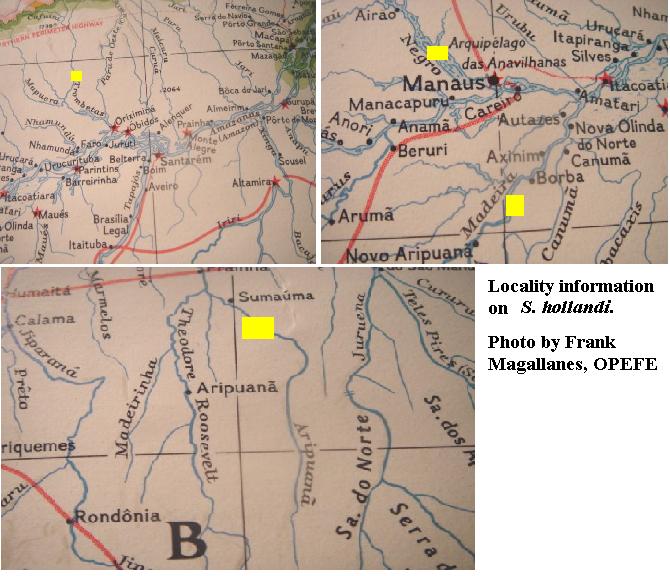 The map to the left, shows a
portion of the range S. hollandi. Serrasalmo hollandi
(Eigenmann, Ann. Carnegie Mus. ix. 1915, p. 251, pl. XIVIII. Depth of body 2 1/6
in the length, length of head about 3 1/3. Upper profile a little concave above
eyes. Snout a little shorter than eye, diameter of which is a little more than
3½ in length of head; interorbital width 2 3/5. Second suborbital of moderate
width, separate from angle of pre-operculum by a space equal to nearly ½
diameter of eye. Lower jaw is projecting; palatines with 5 well-developed teeth.
Ventral serrae 37 (25+ 12?). Dorsal II 14; origin about equidistant from end of
snout and base of caudal; length of base 3 3/5 in depth of body, nearly 1 2/3 in
distance from upper caudal fulcra. Adipose fin not rayed, base about 4, its
distance from rayed dorsal a little less than base of that fin. Anal III 29;
length of base 3 1/4 in that of body, 13/5 in depth of body. Pectoral about 1
3\5 in head. Origin of pelvics nearer last anal ray than tip of lower jaw. Upper
parts of body with round dark spots; a dark blotch on the shoulder; basal part
of caudal dark. Hab. Rio Guaporé. Total length 130 mm (5 inches TL).
The map to the left, shows a
portion of the range S. hollandi. Serrasalmo hollandi
(Eigenmann, Ann. Carnegie Mus. ix. 1915, p. 251, pl. XIVIII. Depth of body 2 1/6
in the length, length of head about 3 1/3. Upper profile a little concave above
eyes. Snout a little shorter than eye, diameter of which is a little more than
3½ in length of head; interorbital width 2 3/5. Second suborbital of moderate
width, separate from angle of pre-operculum by a space equal to nearly ½
diameter of eye. Lower jaw is projecting; palatines with 5 well-developed teeth.
Ventral serrae 37 (25+ 12?). Dorsal II 14; origin about equidistant from end of
snout and base of caudal; length of base 3 3/5 in depth of body, nearly 1 2/3 in
distance from upper caudal fulcra. Adipose fin not rayed, base about 4, its
distance from rayed dorsal a little less than base of that fin. Anal III 29;
length of base 3 1/4 in that of body, 13/5 in depth of body. Pectoral about 1
3\5 in head. Origin of pelvics nearer last anal ray than tip of lower jaw. Upper
parts of body with round dark spots; a dark blotch on the shoulder; basal part
of caudal dark. Hab. Rio Guaporé. Total length 130 mm (5 inches TL).
Jegu, 2001
page 18
(136)
S. hollandi describes the Guaporé Pristobrycon and Eigenmann. Santos
(1990) cites three species Guaporé and reports of the presence of a fourth form
of the Jamari, a right tributary of Madeira, with the caudal edge of the hyaline
and identified S. aureus. These species are all different types of S.
spilopleura. S. hollandi differs from S.
spilopleura by the more general form of
the body rhomboidal, head more slender, the dorsal inserted far forward, the
infraorbital 3 and 4 broader and bare area closer to the cheek (Fig. 8c-e). In
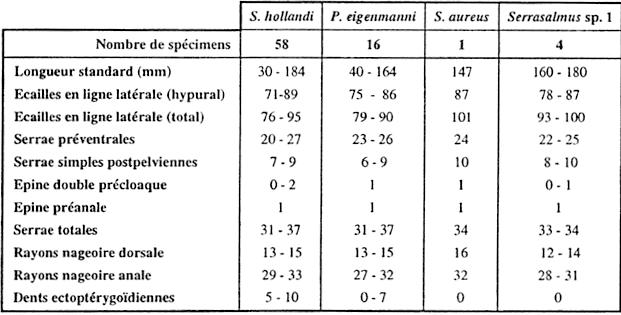
addition, S. hollandi, between 50 and 185 mm SL. This 6-10 pairs of teeth
ectopterygoid (Table VI) against less than 5 S. spilopleura, by
Kner (1858). Finally, the mark at the base of the caudal fin in S.hollandi
is crescent shaped and much narrower than in S. spilopleura.
The type of coloration of the tail of P. eigenmanni is close to
that of S. spilopleura, especially for large specimens in whom the distal
edge of the band tail is straight. The number of teeth is low in ectopterygoid
specimens of P. eigenmanni over 100 mm SL (Table VI).
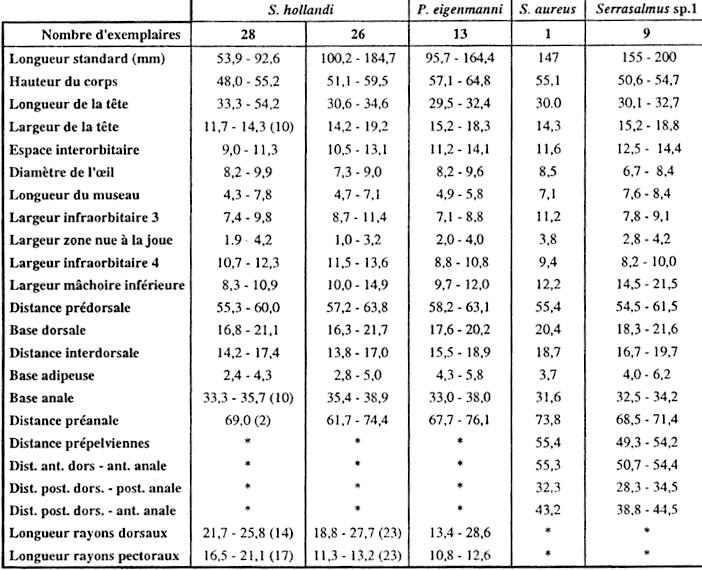
In P. eigenmanni, S. spilopleura, the muzzle is short and pug, narrow infraorbital bones (Fig. 8c 8e) and the large gap in the cheek (Fig. 8d). P. eigenmanni is different types of S. spilopleura by body height (Fig. 8a) and the insertion of the dorsal farther back (Fig. 8b). Moreover, in P. eigenmanni diameter of the eye is slightly larger. Serrasalmus spilopleura and S. maculatus interdorsal distances and longer pre-anal and dorsal and pectoral more shorter than in S. spilopleura (Tableau! VII).
The specimen from the Rio Jamari (Rondonia, Brazil) identified S. aureus by Santos (1990) presents a well-growing fairly large caudal (Fig. 9a), but differs from types of S. spilopleura the narrower interorbital (11.6% of SL vs. 12.3 to 13.8% in S. spilopleura) and the much wider infraorbital 3 (11.2% vs LS less than 9% S. spilopleura). The black spots on the flanks are much larger in this specimen, but we observed such a variation between specimens of P. eigenmanni 130 and 140! Mm SL, from the same collection station (MNHN 1989-1362). Santos (1990: Fig.186) reported Serrasalmus sp.1, the Guaporé and Jamari, including general appearance of the body and morphometric characteristics are very similar to those of S. spilopleura (TableVII), including the level of the infraorbital series. The head and base of the ridge are slightly longer than the types of S. spilopleura. None of these specimens of teeth does the palate. The black dots on the sides, the presence of a humeral marks and gray color of the tip of the first rays of the anal is similar that we observed on the lectotype of S. spilopleura. These specimens differ types of S. spilopleura by the mere presence of a gray to black band located the tip of the tail (Fig. 9b), although specimens have the caudal edge of the most clear.
These specimens can not be identified in S. spilopleura Kner. Examination of additional material from the Guaporé will better appreciate the variability type of coloration of the caudal and possibly expand the diagnosis S. spilopleura. S. spilopleura this type of color much like that of specimens S. gouldingi Fink & Machado-Allison, preserved in alcohol (Fink and Machado-Allison, 1992!: Fig. 2). The two species are not more than five teeth on the palate, teeth have shapes adjacent to the premaxilla (ibid: fig. 8b). But in S. gouldingi 3 covers the infraorbital completely plays while that of S. spilopleura reminds Pristobrycon careospinus (Ibid.: Fig. 8b).
The truncated form of the infraorbital 3 with a wide gap, the low number of ectopterygoid teeth and lower teeth as seen in the premaxilla S. spilopleura also recall the characters of Pristobrycon calmoni, type species of Pristobrycon. Only obtaining new specimens of Serrasalmus spilopleura Kner, 1858, associated with an osteological study finer will better appreciate the relationship of this species with the kind Pristobrycon.
Variability of morphometric characters of Serrasalmus hollandi and Pristobrycon eigenmanni of the Bolivian Amazon (numbers in parentheses indicate the number of specimens examined for these characters).
|
Table VI
|
Table VII
|
To access complete further information VIEW
DNA ANALYSIS
To read information related to this species regarding DNA VIEW
REPORTED SIZE
18.5 cm SL (7 1/4 inches SL) or approximately 9 inches TL.
DISTRIBUTION
Madeira R. basin and ? Guyana rivers: Brazil and Guiana (?).
REFERENCES
Eigenmann, C. H. 1915 (Mar.) The Serrasalminae and Mylinae. Ann. Carnegie Mus. v. 9 (nos. 3-4): 226-272, Pls. 44-58.
Henn, A. W. 1928 (Sept.) List of types of fishes in the collection of the Carnegie Museum on September 1, 1928. Ann. Carnegie Mus. v. 19 (art. 4): 51-99.
Ibarra, M. and D. J. Stewart 1987 (30 Sept.) Catalogue of type specimens of Recent fishes in Field Museum of Natural History. Fieldiana Zool. (N. S.) No. 35: 1-112.
Lasso, C. A., V. Castelló Canales-Tilve, T., and J. Cabot-Nieves 2001 Contribución al conocimiento de la ictiofauna del Río Paraguá, cuenca del Río Itenzen o Guaporé, Amazonía Boliviana. Memoria, Fund. La Salle Cien. Nat. vol. 59 (no. 152): 89-103.
Jégu, M. and G. M. dos Santos 2001 Mise au point à propos de Serrasalmus spilopleura Kner, 1858 et réhabilitation de S. maculatus Kner, 1858 (Characidae: Serrasalminae). Cybium v. 25 (no. 2): 119-143.
Géry, J., 1977 Characoids of the world. T.F.H. Publications, Inc., N.J. 672 p.
Hureau, J.-C., 1991 La base de données GICIM: Gestion informatisée des collections ichthyologiques du Muséum. p. 225-227. In Atlas Preliminaire des Poissons d'Eaux Douce de France. Conseil Supérieur de la Pêche, Ministère de l'Environment, CEMAGREF et Muséum National d'Histoire Naturelle, Paris.
Eschmeyer, W.N., Editor, 1998 Catalog of fishes. Special Publication, California Academy of Sciences, San Francisco. 3 vols. 2905 p.
Muramoto, J., S. Ohno and N.B. Atkin, 1968 On the diploid state of the fish order Ostariophysi. Chromosoma 24(1):59-66.
Klinkhardt, M, M. Tesche and H. Greven, 1995 Database of fish chromosomes. Westarp Wissenschaften.
Anon., 2000 The icthyological collection of the Zoological Museum Hamburg (ZMH). Division of Icthyology and Herpetology, Zoological Museum Hamburg (ZMH)
Jégu, M., 2003 Serrasalminae (Pacus and piranhas). p. 182-196. In: R.E. Reis, S.O. Kullander and C.J. Ferraris, Jr. (eds.) Checklist of the Freshwater Fishes of South and Central America. Porto Alegre: EDIPUCRS, Brasil.
Varjo, M., L. Koli and H. Dahlström, 2004 Kalannimiluettelo (versio 10/03). Suomen Biologian Seura Vanamo Ry.
Hubert, N. and J.-F. Renno 2010 Description of a new Serrasalmus species, Serrasalmus odyssei n. sp. [pp. 52-59]. In: Evolution of the neotropical ichthyofauna -- molecular and evolutionary perspectives about the origin of the fish communities in the Amazon. VDM Publishing House, Verlag Dr. Müller, Saarbücken, Germany. Evolution of the Neotropical Ichthyofauna.: 95 pp.
USE YOUR BACKSPACE TO RETURN OR CLICK HERE TO RETURN SERRASALMUS LIST
USE THIS LINK TO RETURN TO RESEARCH PAGE.
The OPEFE web site and its contents; is disclaimed for purposes of Zoological Nomenclature in accordance with the International Code of Zoological Nomenclature, Fourth Edition, Article 8.3 and 8.4. No new names or nomenclature changes are available from statements at this web site.
Copyright© 1994-2012 Oregon Piranha Exotic Fish Exhibit (The OPEFE fish exhibit is permanently CLOSED as of 2000) Sutherlin, Oregon. Information posted on this web site is archival data on fish scientific classifications and other information. DISCLAIMER: The copyrighted material may not be used for any purpose other than private study, scholarship or research. Cited information requires credit and this link www.opefe.com. All rights reserved. All images shown (unless otherwise noted) is property of OPEFE.
UPDATED: 12/10/2015