 WELCOME TO OPEFE ARCHIVES
Black-Shoulder Spot Parambeba
From Frank Magallanes
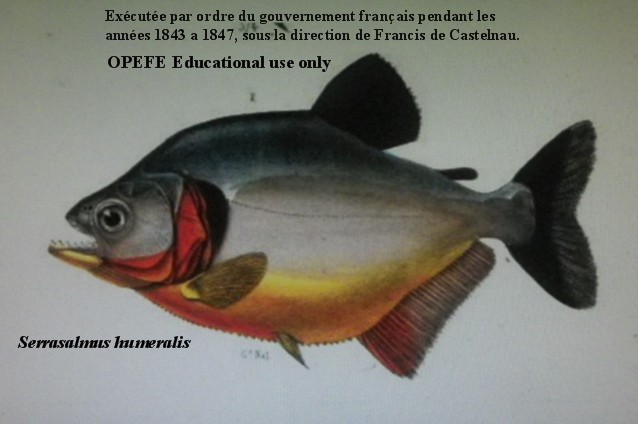
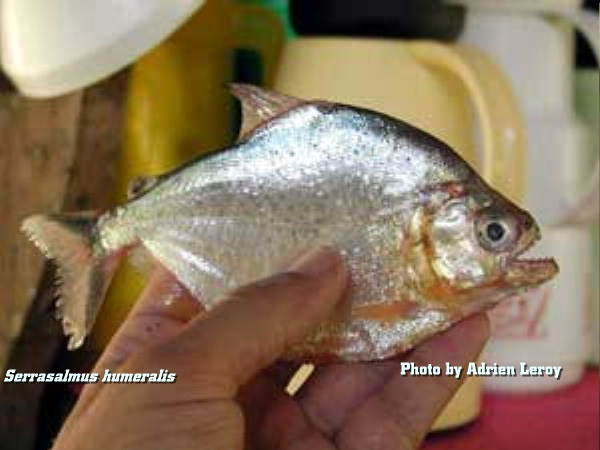
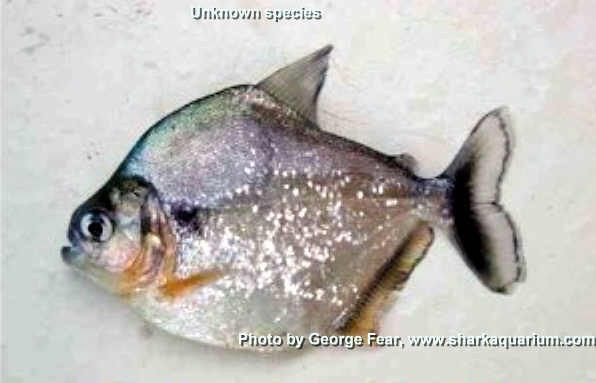
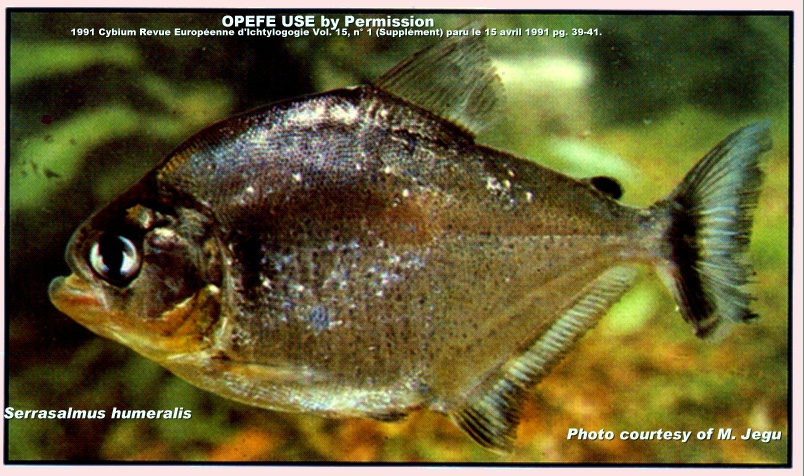
Since writing this species page on S. humeralis, more confusion has surfaced on what S. humeralis is or looks like. Further down below is an illustration and photos identified by several people and scientists, including N. Hubert to be S. humeralis.
According to William Eschmeyer, California Academy of Sciences, they show the following; humeralis, Serrasalmus Valenciennes [A.] in Cuvier & Valenciennes 1850:279 [Histoire naturelle des poissons. v. 22; Amazonas, Brazil [evidently in error for Araguay River, Tocantins basin]. Holotype (unique): MNHN A-9735. Type catalog: Bertin 1948:25. The Holotype is actually a radiography of two fish. I'm presently unsure which one is S. humeralis or if both forms are the same one but in different growth phases VIEW. I hope to have more on this later.
According to recent publications by N. Hubert 2006 et al., (Hubert & Renno 2010) recently provided evidence that the citation of S. eigenmanni in the Madeira was erroneous and originated from confusion with S. spilopleura. (See Jegu Dos Santos, 1988). Ortega & Vari (1986) tentatively placed specimens morphologically very similar to S. spilopleura from the Ucayali within S. humeralis, another closely related species (Jegu & Dos Santos 2001).
Further collections in the future may help provide additional material and hopefully resolve this question of taxonomic placement. S. hollandi, by variance of length may also be resolved within this complex. Hubert & Renno (2010) determined via DNA that S. hollandi is a member of the compressus group. This would effectively remove it from the historical humeralis group. But like S. humeralis, S. hollandi historical descriptions are vague and uncertain. I have no knowledge of a team of experts actually looking at all depositories of S. hollandi from around the world other than those at MNHN. Such an undertaking would certainly be a monumental task. Perhaps in the future, there will be an answer to that riddle.
A problem remains with Pristobrycon scapularis since Gery (1972, 1977) placed this species as a junior synonym of S. serrulatus. S. humeralis from all appearances is a Pristobrycon and not a Serrasalmus based on past historical descriptions, but that may yet be determined by science. Presently, I'm going over the Hubert & Renno publication to see where exactly S. humeralis fits in on his DNA work. More on this later and will be added.
There is much work to be done in this genus and in particular this species since it appears there is a complex of species . At the present time, the species which comprised humeralis group is S. humeralis, S. eigenmanni, S. nalseni, S. hollandi and S. serrulatus needs to be analyzed more thoroughly in my opinion.
Allegedly, a population was found in Dade County Florida (Monkeyland) in the early 1977 (Shafland and Foote 1979; identified as Serrasalmus humeralis). However, preserved specimens from the Miami area deposited at UF were determined by W. L. Fink [personal communication between Leo Nico Florida DNR and W. L. Fink, Voucher specimens: Florida (UF 87975, UF 97059 ) to be S. rhombeus.]
|
Serrasalmus humeralis Note the V
type caudal Serrasalmus humeralis, Cuv, val t XXII p.279, 1849 |
Serrasalmus humeralis Zur Famiiie der Characine III. Folge der Ichthyologischen Reitrage, Kner 1859 Fig. 9 |
Text image Type de S. (Pristobrycon) humeralis, 115 mm 1.sd. (dessin de H.-Ph. Danoy) Géry (1963). |
S. humeralis, Para Brazil My opinion from this photograph is a misidentification. More than likely P. denticulata. |
Rio Xingu Species identified as S. humeralis, fishbase.org. Certainly appears similar to S. manueli, Venezuela |
Rio Xingu Species identified as S. humeralis, fishbase.org also appears similar to S. manueli, Venezuela |
Captured specimen in Guyana by Adrien Leroy. According to Leroy. N. Hubert Identified it S. humeralis, |
Flank view of same species on the left. |
A similar appearing species in the The Piranha Book by G. S. Myers, page 92. |
What I can say with some certainty, S. humeralis looks very much like its Venezuela counterpart S. manueli (VIEW). It is no wonder why hobbyists (including myself) are a bit confused by what scientists are calling S. humeralis. I am trying my best to get a consensus on the identification. However, only the present authority N. Hubert who used the fish for his DNA analysis knows. Perhaps we'll get a better answer and especially a photos in the future.
INTRODUCTION
Castelnau
No. 3 Serrasalmus
humeralis, Cuv, val t XXII p.279
Plate XXXVIII, fig 2
Mr. Valenciennes (1849) described this species on the individual that I reported the Araguaia. It is identical with the preceding as the piranha branca. Another species, similar to that of M. d'Orbigny (Serrasalmus marginatus). is distinguished by sub orbital even closer, they are striated and other parts opercular. The lower jaw is less prominent in front of the superior, of which exceeds the full width of the branch. The snout is rounded convex in front of the nostril, slightly concave over eyes. The interparietal crest is convex.
Color of life
The color is steel blue above the lateral line, silvery on the belly, a black
blemish is very strong behind the ear, back and sides are covered with dark
almost blackish blue spots. Caudal fin has a broad black border. Our type is 5
inches long. It is above a light blue, the belly is orange-yellow and the
posterior edge of the lid and preopercle. Pectoral fins are bright yellow, the
dorsal and the base of the tail black. The rest of the latter is white, the anal
yellow, with its lower part with a red - orange an elongated black spot back of
the head.
Kner
Zur Famiiie der Characine
III. Folge der Ichthyologischen Reitrage, 1859 Fig. 9
1. Art. Serrasalmo humeralis Val.
(Taf. IV, Fig. 9.)
Altitudo ad longitudinem totalem fere ut 1 : 2, capitis longitudo ad illam corporis ut 1 : 3, macula nigra magna retro humerum, minores ad trunci latera, pinna caudalis et analis nigro limhatae.
Um jeden Zweifel über die Richtigkeit der Bestimmung zu heben, gebe ich nebst der Abbildung die Beschreibung dieser Art ausführlicher, als dies von Valenciennes geschah..
Die grösste Körperhöhe unterhalb des Beginnes der Rückenflosse verhält sich zur kleinsten am Schwanze, wie 5%: 1, das Profil der Schnauze ist bis über die Narinen gewölbt, sodann bis zu Ende der Grista occipitis sanft concav, steigt aber hierauf in ziemlich raschem Bogen bis zur Dorsale an; die Höhe am Hinterhaupte beträgt etwas über halbe Körperhöhe. Das Profil der Bauchseite bildet bis zur Analgrube einen flacheren Bogen. — Der Durchmesser des Auges ist 4— 4y3mal in der Kopflänge enthalten; es steht 1 Diameter vom Schnauzenende und eben so weit vom anderen Auge entfernt. Der mächtige knöcherne Augenring verhält sich so, wie er bei Serr. rhombeus beschrieben wird; das über dem grossen 3. befindliche als 4. bezeichnete Stück desselben ist aber weiter nichts als der knöcherne Canal selbst, der dann durch die anderen Augenringknochen sich fortsetzt und Seitenäste an sie abgibt. Der Winkel des kleinen Oberkiefers, der fast ganz vom vorderen tief unter ihn herabreichenden Suborbitalstücke überdeckt wird, kommt unter den vorderen Augenrand zu liegen. Der Unterkiefer ist nur wenig länger als der Zwischenkiefer und bei Weibchen breiter, während er bei Männchen (ähnlich wie bei Lachsen) in einen schmalen stumpfen Haken ausläuft. Die Zahl der Zähne im Zwischenkiefer beträgt bei beiden Geschlechtern jederseits 6, im Unterkiefer 7 ; die Bezahnung der Gaumenbeine erscheint hingegen keineswegs Verlä s sli eh. Sämmliche Individuen, die sich mir bei innerer Untersuchung als M ä n nc h en ergaben, oder von Natterer als solche bezeichnet wurden, besitzen nämlich jederseits eine einfache Reihe von 7—8 kleinen stumpf dreieckigen Zähnen, wie deren in den Ilor. ichthyol. von Serr. rhombeus auf Taf. II in Fig. 4 dargestellt sind, bei Weibchen fehlt hingegen jede Spur derselben, mit Ausnahme eines einzigen trockenen Exemplares, welches Natterer alsfoemina bezeichnete und das links 6, rechts nur 2 Gaumenzähne trägt. Es scheint daher, dass allerdings Gaumenzähne beiden Geschlechtern zukommen, dass sie aber entweder überhaupt durch den Gebrauch leicht oder blos bei Weibchen leichter ausfallen, oder dass, wie es am wahrscheinlichsten ist, auch hier durchwegs ein öfterer Zahnwechsel stattfindet. Die papillösen Schleimhautwülste (bourrelet de la muqueuse) hinter den Zahnreihen, die Valenciennes ganz gut beschreibt, finden sich daher bei Männchen undWeibchen vor, und sie beherbergen die Keime neuer Zähne, die entweder im regelmässigen Wechsel sich neu bilden, oder dann zur Entwicklung kommen, wenn die alten Zähne durch den heftigen Gebrauch, den diese gefürchteten Fische von ihnen machen, verloren gingen. Einigen unserer Exemplare fehlen in der That hie und da Zähne in der Reihe, und gewöhnlich findet sich dann schon ein junger Zahn im Schleimhautwulste hinter der Zahnlücke vor und zwar in liegender Stellung, indem er offenbar erst später.vorschiebt und in ähnlicher Weise an die Stelle des früheren Zahnes rückt, wie dies bei anderen Fischen der Fall ist.
Der Vordeckel überhüllt grösstentheils den Zwischendeckel, der an ihm verlaufende Canal bildet zahlreiche strahlig auslaufende Nebenzweige; das Suboperculum reicht weiter zurück als der ziemlich hohe aber schmale Deckel. Die beiden zuletzt genannten Deckelstücke sind, wie der ganze Suborbitalring, stark gestreift. Die Kiemenspalte ist bis an den Isthmus offen, die Zahl der Kiemenstrahlen meist jederseits 4 (öfters bei Männchen links 5, rechts 4); die Rechenzähne der Kiemenbögen sind kurz, spitz und stehen wie gewöhnlich bei gut bezahnten Fischen ziemlich entfernt von einander; die oberen und unteren Schlundzähne bilden breite Binden von Sammtzähnen, die Zunge ragt mit freier Spitze vor.
5
D. 16, A. 2/32, V. 7, P. 15, C. 19
Die Stellung und übrigen Verhältnisse der Flossen übergehe ich, in soweit sie aus der Abbildung ohnehin ersichtlich sind, nur führe ich an, dass die vorderen getheilten Strahlen der Dorsale kleine seitliche Hautlappen tragen, deren aber die Strahlen der After- und Schwanzflosse ermangeln. Die beiden ersten Strahlen der Anale sind echte Stachelstrahlen, die schwach entwickelten Bauchflossen reichen nicht bis zur Analgrube zurück, die Bauchflossen aber bis zu ihnen, die Strahlen der nur sanft eingebuchteten Caudalc sind mehrfach dichotomisch getheilt. — Längs des Bauchkieles zählt man 26 — 28 kurze, grösstenteils von Schuppen überdeckte Stacheln, von denen die vorderen in eine nach hinten gerichtete Spitze auslaufen, die letzten 13 — 16 aber meisselähnlich eine Schneide bilden; der letzte vor der Analgrube ist kleiner als die vorhergehenden und bei Weibchen in 2 Spitzen getheilt. Hinter der Analgrube ragt ein paariger Dorn mit schneidendem Rande vor, der (vielleicht nur zufällig) bei Weibchen kleiner erscheint. Form und Zahl der Kieldornen variiren übrigens und namentlich sind öfters 2 kleinere statt eines grösseren und breiteren Domes vorhanden.
Die ziemlich leicht abfallenden Schuppen des Rumpfes sind am Rücken am kleinsten und nehmen gegen den Bauchkiel allmählich an Grösse zu; die an den Schultergürtel angrenzende Reihe enthält von allen die grössten. Die Mittellinie des fast eine Schneide bildenden Rückens ist bis zum liegenden Stachel vor der Dorsale unbeschuppt. Der Seitencanal verläuft über halber Körperhöhe fast geradlinig und mündet mit einfachen aber weiten Röhrchen.
Färbung: Die Schuppen des Rückens glänzen stahlblau, die der Seiten silberig, zahlreiche schwärzliche Augenflecke bedecken die Seiten des Rumpfes bis gegen den Bauch herab; ein grosser schwarzer, nicht scharf abgegrenzter Fleck hält das Vorderendo des Seitencanales und die Gegend hinter dem Humerus besetzt. Nebst der bei beiden Geschlechtern breit schwarz gesäumten Caudalc sind auch, und zwar bei Männchen deutlicher, After- und Rückenflosse dunkel gesäumt.
Die Eierstöcke des Weibchens nehmen die ganze Länge und den grössten Raum der Bauchhöhle ein und pressen Darmcanal und Leber zwischen und vor sich ein; sie münden mit weitem Eigange hinter dem Anus. — Die Schwimmblase, deren eigenthümliche Form Valenciennes von der Art Serr. caribe gut beschreibt, verhält sich bei beiden Geschlechtern gleich; Fig. 9 a zeigt sie in der Seitenansicht mit etwas aus einander gezogenen Abtheilungen, um die Aushöhlung der hinteren ersichtlich zu machen, in welche sich die vordere mit ihrer Convexität hineinbettet.
Totallängc unserer Exemplare von 5 bis d1/., Zoll.
Fundorte: Rio Guaporö, Barra de Rio negro, Cujaba und Villa Maria am Rio Paraguay, letztere von Natter er als Salmo tizoura vel Sachicanga bezeichnet..
TRANSLATION
First Article Serrasalmo humeralis Valenciennes
(Plate IV, Fig 9)
Altitudo
ad longitudinem total fere ut 1: 2, capitis longitudo ad Illam corporis ut 1: 3,
macula nigra magna humerum retro, ad minores trunci lateral, pinna caudalis et
nigro limhatae analis.
To
raise any doubt about the correctness of the determination, together with the
figure I give the detailed description of this type, as this was done by
Valenciennes.
The
largest body height below of the beginning of the dorsal fin is to the smallest
of the tail, such as 5%: 1, the profile of the snout to convex on the Narine,
then up to the end of Grista occipitis gently concave, but rises to this in
fairly rapid arc up on
the dorsal and the height at the occiput is slightly more than half the body
height. The
profile of the ventral side is up to Analgrube a flatter arc. -
The diameter of the eye is 4 - 4y3mal included in the length of the head, it is
one diameter from end of snout and as far away from the other eye. The
massive bony eye ring behaves as in Serr. describes rhombeus;
the large to the 3rd situated as 4th designated
section of it is nothing more than the bony canal itself, which then continues
through the other eye ring bone and side branches to deliver them. The
angle of the small upper jaw, which almost completely covers the front of him
reaching down deep under Suborbitalstücke will come under the front edge of the
eye to rest. The
lower jaw is only slightly longer than the premaxillary and wider in females,
while it expires blunt in males (similar to salmon) in a small hook. The
number of teeth in the premaxilla is in both sexes on each side 6, in the
mandible 7, the dentition of the palate bones appears however not extensi s sli
eh Sämmliche individuals who surrendered himself to me in case of internal
investigation as M ä n nc h s, or by Natterer were
designated as such, have any hand that is a simple series of 7-8 small blunt
triangular teeth, as in the ILOR. Ichthyol. of Serr. rhombeus
on Plate II are shown in Figure 4, in contrast, females lacking any trace of
them, marked with the exception of a single dry specimen, which bears the
Natterer alsfoemina and left 6, right palate only two teeth.
It
seems, therefore, get culinary teeth, however, that both sexes, but that they
either did, or merely by the use of slightly lighter in females fail, or that,
as it is most likely also take place here throughout a frequent change of teeth.
The
papillose Schleimhautwülste (bourrelet de la muqueuse) behind the rows of
teeth, the Valenciennes describes quite well, are therefore found in males
before undWeibchen, and they house the germs of new teeth, which are either in
the regular change is new, or come then to develop, if
the old teeth were lost by the heavy use made by these dreaded fish from them. Some
of our specimens are missing, in fact here and there teeth in the series, and
usually there is then already a young tooth in the tooth gap Schleimhautwulste
from behind and while lying down, as he apparently only später.vorschiebt and
in a similar way to the place the
former tooth moves, as is the case in other fish.
The
Vordeckel enveloped in great part on the intermediate cover, which forms about
him running Canal numerous radiating outgoing side branches; the Suboperculum
goes back further than the rather high but narrow lid. The
latter two cover pieces are, as the whole Suborbitalring, strongly striped. The
gill slit is up to the isthmus open, the number of gill rays usually on each
side 4 (often in males left 5, right 4), the teeth on the gill arches are short,
pointed and as usual with good dentate fish at some distance from each other,
the upper and
lower pharyngeal teeth form broad binding Sammtzähnen, the tongue protrudes
with a free tip.
5
D. 16, A. 2 / 32, v. 7,
p. 15, C. 19
The
position and other conditions of the fins I go to that extent it out of the
picture are already apparent, but I may mention that bear the anterior divided
ray of the dorsal small lateral skin flaps, lack thereof, but the rays of the
anal and caudal fin. The
two first rays of the anal fin are real sting rays that reach underdeveloped
pelvic fins not to Analgrube back, but the ventral fins are up to them, only the
rays of the soft indented Caudalc divided several times dichotomous. -
Along the belly keel counts are 26-28 short, covered largely by shed spines,
leak of which the front in a rearward tip, the last 13 - 16 form but
meisselähnlich a cutting edge, the last before the Analgrube is smaller than
the previous divided
into two peaks and in females. Behind
the Analgrube projects a spike paired with cutting edge before, the (perhaps by
accident) appears smaller in females. Shape
and number of spines vary Kiel and especially by the way are often two small
present instead of a larger and larger domes.
The
rather gently sloping shed at the back of the trunk are the smallest and take a
stand against the abdominal keel gradually in size, contains, to the shoulder
belt adjacent set of all the greatest. Forming
the center line of cutting back is almost a unbeschuppt to the underlying spine
before the dorsal. The
canal runs about half a body side height and flows almost straight with simple
but wide tubes.
Staining:
shine the scales of the back steel blue, the silvery of the sides, numerous
blackish eye-spots cover the sides of the fuselage until towards the belly down,
a large black, not sharply defined spot keeps the Vorderendo the page Canales
and the area occupied behind the humerus. In
addition to the black in both sexes broad-lined Caudalc are clearly also, and in
males, anal and dorsal fin edged dark.
The
ovaries of the female to take the whole length and the largest one area of
the abdominal cavity and intestinal tract and liver, squeeze
between and in front of him, they lead by far Eigange behind the anus. -
The swim bladder, whose peculiar shape of the manner Valenciennes Serr. caribe
well describes, behaves the same in both sexes; 9 is a side view shows it in
with something from each other divisions drawn, hineinbettet to the erosion of
the back to make clear what is in the front with its convexity.
Totallängc
our specimens from 5 to d 1 /., Customs.
Habitat:
Rio Guaporö, Barra de Rio Negro, and Villa Maria Cujaba on the Rio Paraguay,
the latter of snake it described as Salmo tizoura Sachicanga vel.
Michel Jegu
Holotype radiograph unique.MNHN A-9735: VIEW
FRENCH
Les Individus recueillis dans l'Oyapock, la Riviere de Kaw et l'Approuague ne different pas significativement de ceux du bassin de l'Araguaia (= "Araguay" selon Castelnau qui y a recueilli le type de S. humeralis), et dont la description complementaire a ete fait par l'un de nous (Gery, 1964, 1972, 1979), mais ils ont un peu plus de serrae : 30-36 mode 33, chez 28 ex. de Kaw-Approuague, et 30-35, mode 31-32, chez 16 ex. de l'Oyapock, ce qui les rapproche du type de l'espece (38), tres problement anormal a cet egard (puisque, jusqu'a present, un seul exemplaire, de l'Aripuana, a ete trouve porteur de (37 serrae). Rayons ramifies de l'anale 29-31, mode 30-31, sur 44 ex. des deux bassins (meme distribution). Escailles 72-82 en ligne laterale. Dents pterygoidiennes au nombre diminuant avec l'age, 5-7 jusqua 100 mm LS, et 3 ou 4 ensuite; un individu de 180 mm LS na plus de dents pterygoidiennes.
Le tableau XII donne les principales proportions de 12 individus de l'Approuague de 75-176 mm LS; hauteur 1,71-1,87 (Moyenne 1,79, s=0.05) et tete 3,12-3,45 (moyenne 3,25, s = 0.1) fois dans la LS. Le rapport hauteur/tete (peut-etre discriminant dans la comparaison avec S. serrulatus, syn. scapularis) est de 1,7 a 1,95 environ (2,05-2,55 chez 17 ex. de S. serrulatus).
Une tache humerale triangulaire, assez diffuse mais bien apparente chez les grands exemplaires bien conserves; une grande tache en croissant a la base de la caudale, caracteristique de l'espece; pas de bande caudale marginale, mais parfois la partie submarginale de la caudale, chez les tres grands exemplaires, est un peu plus fonces; les individus de l'Oyapock ont generalement de petites taches grises parsement les flancs et unde bande noire a la base de l'anale; ceux de l'Approuague de meme (vers 150 mm) ont le corps non tachete, la ligne a base de l'anale tres peu visible, mais en revanche les ventrales et l'adipeuse noiratres (des la taille de 75 mm LS) (de telles modifications dans le type de coloration des Serrasalmus dependent souvent de la nature de l'eau).
ENGLISH TRANSLATION (Not to be considered accurate translation)
The Individuals collected in the Oyapock, the Rio Kaw and the Approuague do not differ significantly of those of the Rio Araguaia ( = "Araguay" according to Castelnau who collected the type of S. humeralis), and of which the supplementary description was done by the one of us (Géry, 1964, 1972, 1979), but they have a little more serrae: 30-36 usually 33, with 28 ex. of Kaw-Approuague, ex. 16 with those of Oyapock, which comes close to the type of the type (38), very abnormal problem in this respect since, so far, a single specimen of Aripuana, was found with differences (37 serrae). Branched rays of the anal total 29-31, usually 30-31, 44 on the two basins (same distribution). Scales 72-82 in lateral line. Ectopterygoid teeth number diminishing with the age, 5-7 until 100 mm SL, and 3 or 4 next; an individual of 180 mm SL has not anymore Ectopterygoid teeth. The picture XII gives the principal proportions of 12 individuals of the Approuague of 75-176 mm SL; height 1.71-1.87 (average 1.79, s = 0.05) and head 3.12 - 3.45 (average 3.25, s = 0.1) times in the SL. The head width reported (maybe differentiating in the comparison with S. serrulatus, syn. scapularis) is 1.7 to 1.95 about (2.05 - 2.55 with 17 former one of S. serrulatus).
A humeral triangular spot, very prominent and very apparent with the large preserved specimens; a large dark margin at the base of the caudal fin, characteristic of the type; *not any marginal tail band, but sometimes a sub-marginal of the tail fin (See fig. 1 and fig. 2), with the very big specimens, a little more prominent; the individuals of the Oyapock generally have small gray spots sprinkling the flanks and a black band at the anal base; those of the Approuague (about 150 mm) have the body non-spotted, the line to anal base not very visible, but on the other hand the ventral ones and the blackish adipose (as young as the size of 75 mm SL) (of such modifications in the coloring type of the Serrasalmus depend often nature of water).
*According to Hubert & Renno, 2010, Jegu misidentified this specimen. It was S. eigemanni. This was placed as S. spilopleura.
DISCUSSION
FRENCH
En diffentes occasion, nous avons pu examiner des toptypes de Serrasalmus eigenmanni Norman (Guyana), le type de S. humeralis et des exemplaires topotypiques de l'Araguia, et de nombreux examplaires amazoniens de l'espece, en particulier du bassin du Rio Madeira et du Xingu. Nous n'avons pu trouver aucun caractere discriminant permettant de separer eigenmanni de humeralis, defini par le type de l'Araguaia (bien figura par Castelnau, qui ne montre aucune bande marginale a la caudale) et par les exemplaires recueillis depuis dans l'Araguay (cf. Gery, 1979 pls. VII et VIII). La synonymie de S. eigenmanni est donc des plus probables.
Au cours d'une expedition recente (7.1989) dans l'Arataye, affluent de l'Approuague, et apres la redaction de ce travail, MM. Boujard, Meunier et Pascal ont decouvert une forme sympatrique de S. humeralis qu l'on pourrait qualifier de jumelle si elle n'etait pas reconnaissable (sur le terrain seulement) a sa couleur differente. Parvenus au laboratoire, les trois exemplaires recoltes se sont reveles effectivement tres semblables par les caracteres morphometriques, mais ils semblent un peu plus allonges et pourraient etre rapportes, a titre d'hypothese, a S. hollandi. Il faut attendre un materiel plus abondant et une connaissance precise de la colloration in vivo grace a des diapositives pour se prononcer. Aussi, cette forme n'est-elle pas comprise dans le compte des especes de l'Oyapock et de l'Approuague.
N.B. - Serrasalmus rhombeus n'a ete recueilli ni dans l'Oyapock ni dans l'Approuague: sa niche ecologique est peut-etre occupee par S. humeralis. Des vicariances du meme ordre ont ete constatees dans certains fleuves cotiers de Guyane (voir conclusion), et nous esperons revenir sur la description et la distribution geographique de ces especes dans un futur travail (Jegu, 1991).
ENGLISH TRANSLATION
In different occasions, we were able to examine topotypes of Serrasalmus eigenmanni Norman (Guyana), the type of S. humeralis and exemplary topotypes of the Araguia, and many examplary Amazonia of the type, in particular basin of the Rio Madeira and Xingu. We were not able to find any differentiating character allowing separating eigenmanni from humeralis, defined by the type of the Araguaia (well figured by Castelnau, that does not show no marginal band to the tail one) and by the samples collected since in the Araguay (cf. Géry, 1979 pls. VII and VIII). The synonym of S. eigenmanni is therefore more probable. During a recent expedition (7.1989) in the Arataye, flow Approuague, and after the compilation of this work, MM. Boujard, Meunier and Easter discovered a sympatric form of S. humeralis which one could qualify as a twin one if it were not recognizable (in the field only) to its different flows. Examined in the laboratory, the three harvested specimens revealed themselves effectively very similar by the morphometric characters, but they seemed a little more lengthened and could be placed, by way of hypothesis, to S. hollandi. It is necessary to await a more abundant collection and specific knowledge of the live coloration thanks in part to. Also, this form is not fully understood in the account of the types of the Oyapock and Approuague.
N.B. - Serrasalmus rhombeus was not collected or in the Oyapock or in the Approuague: Its ecological niche maybe occupied by S. humeralis. Variance of the same order were noted in certain coastal rivers of Guyana (to see conclusion), and we inspire to go back over the description and the geographic distribution of these types in a future work (Jegu, 1991).
HISTORICAL DESCRIPTIONS - Courtesy of Google Books
DISTRIBUTION
Amazon River basin: Bolivia, Brazil and Peru.
MAXIMUM SIZE
20.0 cm SL (?) (7.8 inches SL) or approximately 9 inches TL.
Contributors and Advisers
Jegu, Michel
REFERENCES
Cuvier, G. and A. Valenciennes 1850 (Jan.) Histoire naturelle des poissons. Tome vingt-deucieme. Suite du livre vingt-deuxieme. Suite de la famille des Salmonoides. Table generale de l'Histoire Naturelle des Poissons (pp. 1-91). Hist. Nat. Poiss. v. 22: i-xx + 1 p. + 1-532 + 1-91, Pls. 634-650. [Valenciennes authored volume. Published as 1849. i-xvi + 1-395, index 1-81 (+ 1) in Strasbourg edition.]
Bertin, L. 1948 Catalogue des types de poissons du Museum national d'Histoire Naturelle. 3e partie. Ostariophysaires (Characiniformes, Gymnotiformes). Cat. Fish Types, Paris 3e partie: 1-49.
Ortega, H. and R. P. Vari 1986 (10 Oct.) Annotated checklist of the freshwater fishes of Peru. Smithson. Contrib. Zool. No. 437: iii + 25 p.
Gery, J., P. Planquette and P.-Y. Le Bail 1991 (15 Apr.) Faune characoïde (poissons ostariophysaires) de l'Oyapock, l'Approuague et la riviere de Kaw (Guyane Française). Cybium v. 15 (no. 1, suppl.): 1-69, Pls. 1-20.
Planquette, P., P. Keith and P.-Y. Le Bail 1996 Atlas des poissons d'eau douce de Guyane (Tome 1). Museum National d'Historie Naturelle, Ministere de l'Environnement. Atlas Poissons Guyane: 1-431.
Cope, E. D. 1872 (16 Jan.- 13 Feb.) On the fishes of the Ambyiacu River. Proc. Acad. Nat. Sci. Phila. v. 23: 250-294, Pls. 3-16. [Presentation date on volume is 16 Jan. for pp. 250-276, 13 Feb. for pp. 277-294.]
Bohlke, E. B. 1984 Catalog of type specimens in the ichthyological colletion of the Academy of Natural Sciences of Philadelphia. Acad. Nat. Sci. Philad. Spec. Publ. 14: i-viii + 1-246.
Gery, Jacques., Contributions A L'etude des Poissons Characoides-27 Systematique et Evolution de Quelques Piranhas (Serrasalmus) Estrait de <<Vie et Milieu>> Tome XIV-1963- Fascicule 3 - pg. 597 a 617.
Jegu, Michel. 1991 Cybium Revue Europenne d'Ichtylogogie Vol. 15, n° 1 (Supplement) paru le 15 avril 1991 pg. 39-41.
Citation for Invasive species and rehabilitation of the scientific name, S. rhombeus is found this information: Leo Nico, 11/13/03, Serrasalmus rhombeus . Nonindigenous Aquatic Species Database, Gainesville, FL. http://canal.er.usgs.gov
Description of a new Serrasalmus species, Serrasalmus odyssei n. sp. [pp. 52-59]. In: Evolution of the neotropical ichthyofauna -- molecular and evolutionary perspectives about the origin of the fish communities in the Amazon. VDM Publishing House, Verlag Dr. Muller, Saarbucken, Germany. Evolution of the Neotropical Ichthyofauna.: 95 pp.
On-line version at www.fishbase.org
Kner, Rudolph Zur Famiiie der Characine III. Folge der Ichthyologischen Reitrage, 1859 Fig. 9.
Hubert, N. and J.-F. Renno 2010 Description of a new Serrasalmus species, Serrasalmus odyssei n. sp. [pp. 52-59]. In: Evolution of the neotropical ichthyofauna -- molecular and evolutionary perspectives about the origin of the fish communities in the Amazon. VDM Publishing House, Verlag Dr. Müller, Saarbücken, Germany. Evolution of the Neotropical Ichthyofauna.: 95 pp.
William Eschmeyer California Academy of Sciences (CAS) ON LINE VERSION VIEW
USE YOUR BACKSPACE TO RETURN TO SERRASALMUS LIST
USE THIS LINK TO RETURN TO RESEARCH PAGE.
The OPEFE web site and its contents; is disclaimed for purposes of Zoological Nomenclature in accordance with the International Code of Zoological Nomenclature, Fourth Edition, Article 8.3 and 8.4. No new names or nomenclature changes are available from statements at this web site.
Copyright© 1994-2012 Oregon Piranha Exotic Fish Exhibit (The OPEFE fish exhibit is permanently CLOSED as of 2000) Sutherlin, Oregon. Information posted on this web site is archival data on fish scientific classifications and other information. DISCLAIMER: The copyrighted material may not be used for any purpose other than private study, scholarship or research. Cited information requires credit and this link www.opefe.com. All rights reserved. All images shown (unless otherwise noted) is property of OPEFE.
UPDATED: 12/10/2015